Engineering//5 min read/Jason Gordon
The Hidden Cost of Technical Debt: When to Rebuild vs. Patch
A lot of people have been asking us how to know when their aging software is costing more to maintain than it would to replace. Here's the framework we use with our clients.
What Is Technical Debt: Really?
Technical debt is the gap between how your software works today and how it should work to support your business goals. It accumulates silently, through quick fixes, outdated libraries, undocumented workarounds, and features bolted onto architectures that were never designed for them.
Unlike financial debt, technical debt doesn't come with a statement. There's no invoice showing you what it costs each month. Instead, it manifests as slower feature releases, more bugs in production, frustrated developers, and, eventually, lost revenue.
The Compounding Problem
Technical debt compounds like interest. A shortcut taken in Year 1 becomes a constraint in Year 2, a blocker in Year 3, and a crisis in Year 4. The longer you wait, the more expensive every option becomes.
The Real Numbers: What Technical Debt Actually Costs
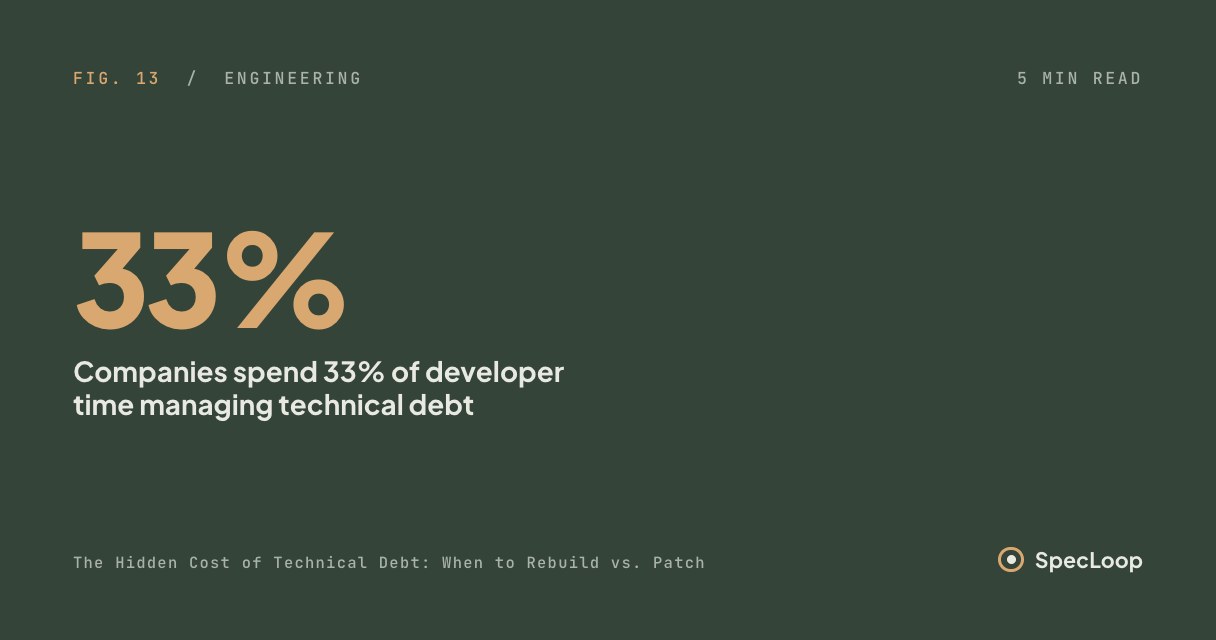
- 33%: Developer time spent on debt
- $85B: What bad code costs companies each year (Stripe estimate)
- 23% and 60%: regressions per change and longer onboarding for new engineers, in our own client audits
These numbers aren't abstractions. When a third of your engineering capacity is spent working around problems instead of building new value, you're effectively paying three developers for the output of two.
The Patch vs. Rebuild Decision Framework
The most common question we hear from CTOs is: "Should we keep patching or start over?" The answer depends on five factors we evaluate in every engagement.
| Factor | Patch | Rebuild |
|---|---|---|
| Core architecture still sound? | ✅ Yes, patch | ❌ No, rebuild |
| Can you ship features in < 2 weeks? | ✅ Velocity is fine | ❌ Everything takes months |
| Dependency on deprecated tech? | ⚠️ Minor, can upgrade | ❌ Framework is EOL |
| Team can onboard in < 1 week? | ✅ Docs exist | ❌ Only one person knows it |
| Security audit passes? | ✅ Clean | ❌ Critical vulnerabilities |
The "Two of Five" Rule
If two or more factors fall in the "Rebuild" column, patching is almost certainly more expensive over 18 months than a clean rebuild. We've validated this across 40+ engagements.
When Patching Makes Sense
Patching isn't always the wrong answer. In fact, for many businesses it's the pragmatic choice, especially when the core system works and the debt is concentrated in specific areas.
- The architecture is fundamentally sound and scalable
- Debt is isolated to one module or service (not systemic)
- You have strong documentation and institutional knowledge
- The tech stack is still actively maintained and supported
- You need to ship a critical feature in < 30 days
In these cases, targeted refactoring, rewriting the worst modules while preserving the rest, delivers the best ROI. We've done this for clients who needed to modernize their payment processing layer without touching the rest of a working ERP.
When It's Time to Rebuild
Rebuilding sounds scary. It's expensive, it's disruptive, and it feels like starting from zero. But here's what most people miss: you're not starting from zero. You're starting with complete domain knowledge, validated business logic, and real user feedback. That's an enormous advantage.
- More than 40% of dev time goes to maintenance and bug fixes
- Your framework or language is end-of-life (e.g., AngularJS, PHP 5, Python 2)
- Only one or two people understand the codebase
- You can't pass a basic security audit
- Adding a simple feature takes weeks instead of days
- You're paying for 3+ SaaS tools because your system can't do what it should
The Single Point of Failure Risk
If only one person understands your system, you don't have a codebase, you have a hostage situation. This alone justifies a rebuild, because that person could leave tomorrow.
The AI-Accelerated Rebuild: Why 2026 Is Different
Three years ago, a full rebuild of a mid-complexity business application took 6–12 months. Today, with AI-assisted development, we routinely deliver production-grade rebuilds in 14–30 days.
| What we deliver | Figure |
|---|---|
| Days to a production rebuild | 14–30 |
| Faster than a traditional rebuild, on our engagements | ~60% |
| Code ownership retained by the client | 100% |
| Starting price for an AI-enhanced build | $7,500 |
This isn't about cutting corners. AI handles the boilerplate, auth flows, CRUD operations, data migrations, responsive layouts, while our engineers focus on the business logic, integrations, and edge cases that make your application unique.
The best time to rebuild was before technical debt started compounding. The second best time is now, while, in our experience, AI makes it roughly 60% faster and 40% cheaper than it was two years ago.
Jason Gordon, SpecLoop
A Real Example: From Legacy PHP to Modern Stack in 21 Days
A logistics client came to us with a 12-year-old PHP application that managed their entire dispatch and invoicing workflow. The system worked, barely. Every change required the original developer (a contractor who charged $200/hr and had a 2-week response time). A single invoice template change took 3 weeks and $2,400.
- Mapped all existing business logic and data relationships in 3 days
- Built the new system on React + Edge Functions with real-time updates
- Migrated 8 years of historical data with zero loss
- Deployed to production on Day 21 with the old system running in parallel
- Cut the client's monthly software costs from $4,200 to $89 (hosting only)
- New features now ship in 1–3 days instead of 3+ weeks
The TCO Comparison: 3-Year View
| Cost Category | Keep Patching | Full Rebuild |
|---|---|---|
| Year 1 maintenance/build | $48,000 | $7,500–$15,000 |
| Year 2 maintenance | $58,000 (+20%) | $3,600 (hosting + support) |
| Year 3 maintenance | $72,000 (+25%) | $3,600 |
| Lost productivity (3yr) | $120,000+ | $0 |
| 3-Year Total | $298,000+ | $14,700–$22,200 |
| New feature velocity | Weeks per feature | Days per feature |
The Payback Period
In every client engagement where we've done a full rebuild, the investment paid for itself within 14 months, usually through eliminated contractor costs, reduced SaaS subscriptions, and faster time-to-market.
How to Start: The Technical Debt Audit
Before deciding anything, you need a clear picture of where you stand. Here's the process we follow with every new engagement:
- Inventory: Map every system, integration, and data flow
- Dependency check: Identify EOL frameworks, unsupported libraries, and security vulnerabilities
- Velocity audit: Measure actual time-to-ship for recent features vs. estimated time
- Bus factor assessment: Document who knows what, and what happens if they leave
- Cost modeling: Calculate true monthly cost of maintaining the status quo
This audit typically takes 2–3 days and produces a clear recommendation with concrete numbers. No guessing, no gut feelings, just data.
Sources & references
Frequently asked
Questions people ask about this
- If the total cost of the last 12 months of maintenance, downtime, and workarounds exceeds one-third of a full rebuild cost, rebuild. If you're afraid to touch the codebase, rebuild. If the platform blocks a strategic feature, rebuild.
About the author
Jason Gordon
Founder, SpecLoop
Jason Gordon is the founder of SpecLoop, a spec-driven AI development studio that builds production-grade business applications from a complete specification, in weeks, at flat rate, with 100% code ownership. He also builds GeoTest, a free tool that scores how visible a site is to AI search engines. He writes about AI search, spec-driven development, and why most AI builds never reach production.
Keep reading
Related posts
Engineering
Vibe Coding Is Not Engineering: The QA Gap That's Costing Mid-Market Teams Their Reputation
AI agents can now generate full applications from a prompt. But the difference between a demo that impresses on Twitter and software that runs a business is testing, architecture, and operational discipline. Here's the line most teams are missing.

GEO & AI Search
Why Blog Posts Should Be 2,500+ Words If You Want AI to Cite You
A lot of people have been asking us why we recommend long-form content for every client's blog strategy. The short answer: AI search engines don't cite thin content. Here's the full breakdown, the data, the mechanics, and the framework for getting your content quoted by ChatGPT, Perplexity, and Google AI Overviews.
Business Strategy
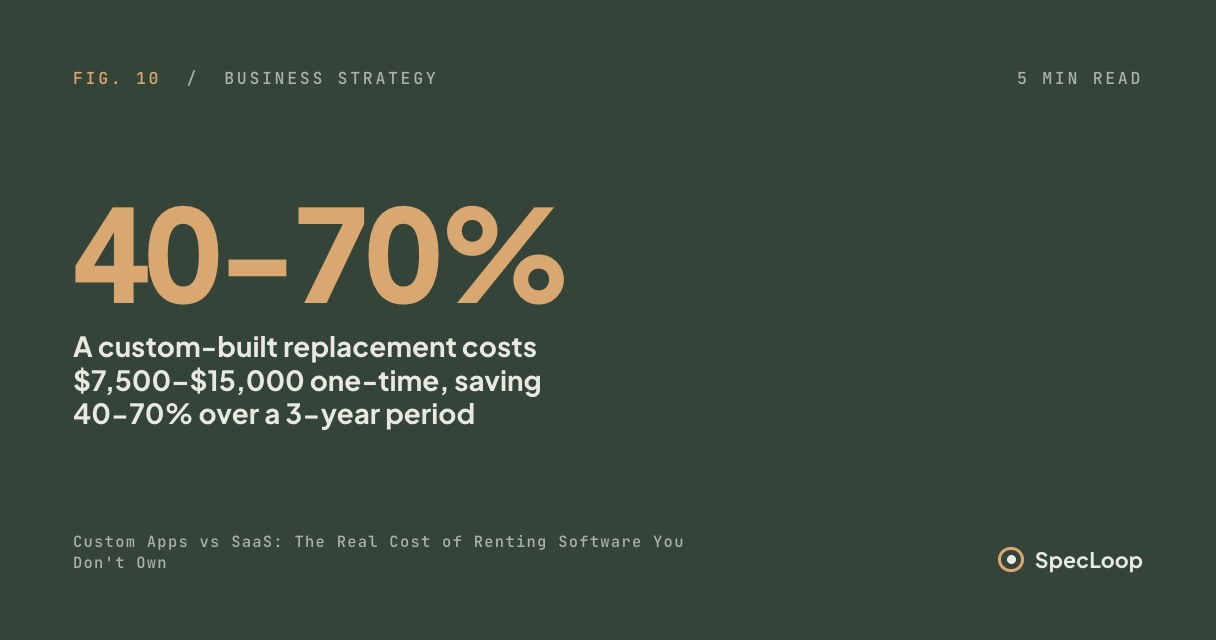
Custom Apps vs SaaS: The Real Cost of Renting Software You Don't Own
A lot of business owners have been asking us whether it makes more sense to keep paying monthly SaaS subscriptions or invest in custom-built software they own. We ran the numbers. The answer might surprise you.
AI Development
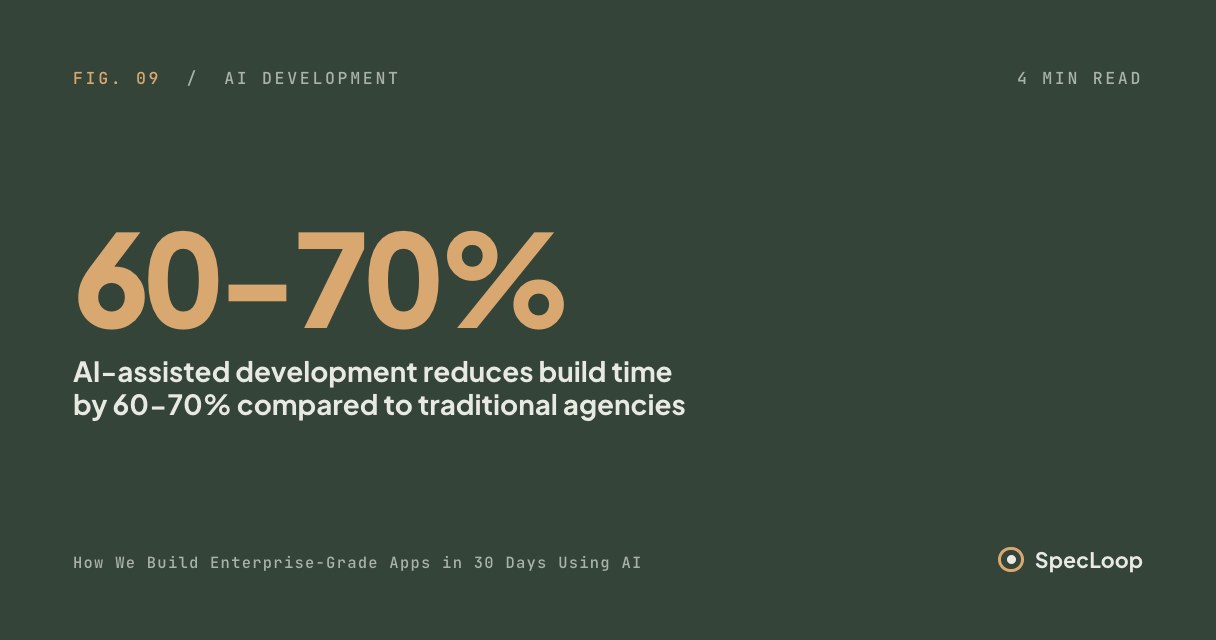
How We Build Enterprise-Grade Apps in 30 Days Using AI
A lot of people have been asking how we ship production-ready, full-stack business applications in 30 days at a flat rate. Here's exactly how our AI-powered development process works, and why it delivers enterprise-grade results faster than traditional agencies.
Next step
Want a spec for your build?
We write the full specification before any code is generated, then ship in 30–60 days at one flat rate. You own every line.