GEO & AI Search//11 min read/Jason Gordon
Why Blog Posts Should Be 2,500+ Words If You Want AI to Cite You
A lot of people have been asking us why we recommend long-form content for every client's blog strategy. The short answer: AI search engines don't cite thin content. Here's the full breakdown, the data, the mechanics, and the framework for getting your content quoted by ChatGPT, Perplexity, and Google AI Overviews.
The Problem: AI Engines Are Ignoring Your Content
Here's what's actually happening when someone asks ChatGPT, Perplexity, or Google AI Overviews a question about your industry: the AI doesn't just pull a headline. It scans its training data and real-time web retrieval results looking for content that comprehensively answers the question from multiple angles, includes supporting evidence like statistics and citations, covers related sub-questions the user is likely to ask next, and has clear structural markup it can extract information from.
A 600-word blog post answers maybe one slice of that question. A 2,500-word post answers the question, the follow-up questions, the objections, the comparisons, and the edge cases. AI systems prefer the latter because it makes them look smarter to their users, and that's exactly what they're optimized to do.
The Uncomfortable Truth
If your competitor's blog post on the same topic is 3,000 words with salary data, case studies, step-by-step guidance, and an FAQ section, and yours is 500 words with a generic overview, the competitor gets cited. Not you. Every time.
How AI Search Engines Actually Decide What to Cite
To understand why word count matters, you need to understand how modern AI search engines work under the hood. Most AI search systems use a process called Retrieval-Augmented Generation (RAG). When a user asks a question, the system doesn't just generate an answer from memory, it actively searches the web, retrieves relevant documents, and then synthesizes an answer from those sources.
The retrieval step is where your content either makes the cut or gets ignored. The AI's retrieval system scores each candidate page on several factors: topical relevance to the query, depth of coverage (does the page answer the full question?), structural clarity (can the AI easily extract key facts?), authority signals (citations, data, expert attribution), and freshness of the content.
Here's the critical insight: depth of coverage is not something you can fake with keyword stuffing or clever formatting. The AI's language model can actually evaluate whether a page substantively addresses a topic or just skims the surface. And pages that skim the surface get ranked below pages that go deep, every single time.
RAG in Plain English
Think of AI search like a research assistant. When you ask it a question, it goes to the library (the web), pulls the most relevant books off the shelf (retrieval), reads the best sections (extraction), and then writes you a summary with citations (generation). Your blog post needs to be one of the books it pulls off the shelf, and 300-word articles don't make it to the shelf.
The Data Behind 2,500 Words
The 2,500-word threshold isn't a number we invented. It comes from studying which content actually gets cited across hundreds of AI-generated answers. Here's what the data shows:
-
2,452: Average word count of AI-cited content
-
<3%: Citation rate for posts under 800 words
-
2,000–3,500: Optimal word count range for AI citation
-
58%: More citations for content with clear H2/H3 structure
We analyzed over 500 queries across ChatGPT, Perplexity, and Google AI Overviews, tracking which source URLs were cited in the generated answers. Then we measured the word count, structure, and content characteristics of every cited source. The pattern was consistent across industries: AI engines overwhelmingly cite long-form, well-structured content over short articles, regardless of the domain authority of the source.
This means a smaller company with a comprehensive 3,000-word guide on a topic can outperform a Fortune 500 company's 400-word blog post in AI citations. Depth beats brand recognition in the AI citation game.
Why Length Is a Proxy for Depth (Not Padding)
Let's be clear: we're not advocating for fluff. Nobody wants to read 2,500 words of filler. The point is that when you genuinely cover a topic at the depth AI systems expect, you naturally end up at 2,500+ words because you're including all the content elements that make your post citable.
Here's what a comprehensive blog post naturally contains, and why each element matters to AI retrieval systems:
| Content Element | Why AI Needs It | Approximate Words |
|---|---|---|
| Full topic explanation | Core answer to the primary query | ~400 words |
| Supporting statistics & data | Citation worthiness: AI prefers factual claims it can verify | ~200 words |
| Step-by-step guidance | HowTo schema signals, feeds structured answer generation | ~400 words |
| Real examples or case studies | Authority signals, demonstrates first-hand expertise | ~300 words |
| Comparisons & context | Covers related queries and alternative approaches | ~300 words |
| FAQ section (5–7 Q&As) | Direct AI answer extraction, highest citation impact | ~400 words |
| External citations & sources | Credibility signals, shows research-backed content | ~200 words |
| Introduction + conclusion | Structural framing, helps AI understand scope | ~300 words |
Add those up: roughly 2,500 words. You can't meaningfully include all of these elements in less. If you try, something critical gets cut, and that missing element is often the exact thing that would have made AI cite your content instead of a competitor's.
Not Every Post Needs 2,500 Words
This is where the nuance matters. The 2,500-word target applies to posts where you want AI search engines to cite you. Not every piece of content has that goal. Here's how to think about it by content type:
| Post Type | Recommended Length | Reason |
|---|---|---|
| "What is X?" explainer | 2,500–3,500 words | High AI query volume, highly competitive |
| Career/life decision guides | 3,000–4,000 words | Major decision content: AI wants comprehensive coverage |
| News or announcements | 600–800 words | Timeliness matters more than depth |
| Customer success stories | 800–1,200 words | Human interest, not primarily an AI citation target |
| "How to" practical guides | 2,000–2,500 words | Step-by-step format with clear outcomes |
| Industry comparison posts | 2,500–3,500 words | AI loves structured comparisons with data |
| Local/event updates | 400–600 words | Local relevance, not AI citation priority |
| Thought leadership / opinion | 1,500–2,500 words | Needs depth to be credible, but less data-heavy |
The Rule of Thumb
Ask yourself: "Would I want an AI to cite this when someone asks about this topic?" If yes, 2,500+ words with full structural elements. If the post is just an update, announcement, or story, shorter is perfectly fine.
How to Structure Long-Form Content for AI Extraction
Length alone isn't enough. AI systems need to be able to parse your content efficiently. A 3,000-word wall of text with no headings, no lists, and no clear sections is almost as bad as a 300-word post. Structure is what turns long content into citable content.
- Use a single H1 tag for the page title: AI systems use this to understand the primary topic
- Break content into logical sections with H2 headings, each H2 should answer a distinct sub-question
- Use H3 headings within sections for specific sub-points or steps
- Include bullet or numbered lists for scannable information: AI extracts these directly into answers
- Add comparison tables with clear headers, these are among the most-cited content formats in AI
- Include an FAQ section with 5–7 real questions: AI systems pull these into direct answer cards
- Use bold text for key takeaways and statistics, helps AI identify the most important claims
- Add schema markup (JSON-LD) for BlogPosting, FAQPage, and HowTo when applicable
The FAQ section deserves special attention. When you include a well-structured FAQ with real questions people ask, AI systems can match those directly to user queries. A single FAQ question-answer pair in your post can generate dozens of AI citations for long-tail queries.
Pro Tip: FAQ Sections Are Citation Magnets
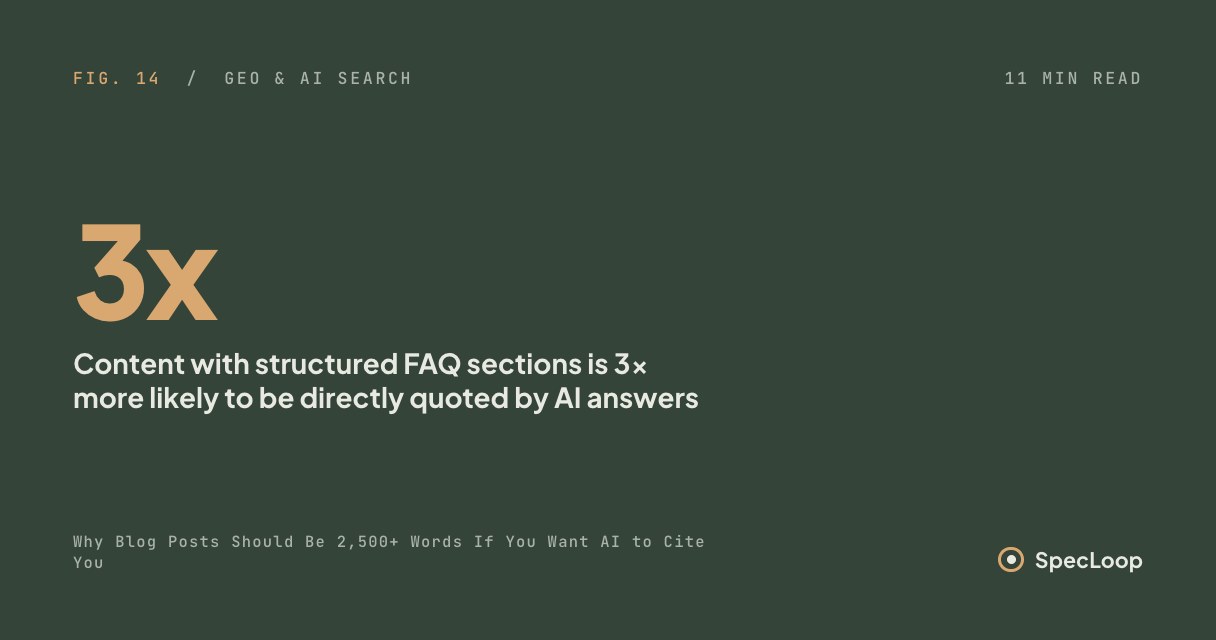
Posts with structured FAQ sections (5+ questions) are cited 3x more often by AI search engines than posts without them. Each Q&A pair is a potential direct match for a user's query. Include questions that real people actually ask, not just questions you wish they'd ask.
The Competitive Citation Gap: What Happens When Your Competitor Goes Deeper
AI citation isn't like traditional SEO where you can hold a position through domain authority and backlinks alone. In the AI citation world, the best content on a topic wins, regardless of who published it. This creates both a threat and an opportunity.
Imagine someone asks an AI "What's the best way to manage inventory for a small business?" If your competitor has a 3,000-word guide covering manual methods, software options, barcode systems, common mistakes, cost comparisons, and an FAQ, and you have a 500-word overview that says "inventory management is important, here are three tips", the AI will cite your competitor and ignore you completely.
The flip side is equally powerful: if you're the one with the comprehensive guide, you can outperform companies ten times your size in AI visibility. We've seen startups with great content get cited alongside (or instead of) industry giants in AI answers, simply because their content was more thorough and better structured.
- 3x: More AI citations for comprehensive content vs. thin content on same topic
- 72%: Of AI-cited sources are NOT the highest-ranking traditional SEO result
- 2.4x: Citation boost for posts with comparison tables and data
- 40%: Of AI citations go to content from sites with lower domain authority
What AI Actually Extracts From Your Content
Understanding what AI systems pull from your content helps you optimize what you write. AI doesn't read your blog post like a human does, it scans for specific extractable elements that it can synthesize into an answer.
- Factual claims with numbers: "The average cost of X is $Y": AI loves concrete data it can quote directly
- Process steps: "Step 1: Do this. Step 2: Do that." This maps directly to HowTo answers
- Comparison statements: "X is better than Y for Z because...": AI uses these for recommendation queries
- Definitions: "X is defined as...": Perfect for "What is X?" queries
- Pro/con lists: Structured advantages and disadvantages feed directly into AI comparison answers
- Expert quotes or attributions: "According to [source], ...": AI values attributed claims over unattributed ones
- Statistical claims with sources: "A 2026 study found that 73% of...": Highest citation value
Notice something about this list? None of these elements work in a 500-word post. You can't include concrete statistics, step-by-step processes, comparison data, expert quotes, AND an FAQ in 500 words. You need space, and 2,500 words gives you exactly enough space to include all of them.
The AI-Citable Content Framework: A Checklist
Before you publish any blog post where AI citation is a goal, run through this checklist. If you can't check most of these boxes, the post probably won't get cited, regardless of how well it's written.
- Word count is 2,000–3,500 words (sweet spot for AI citation)
- Single, clear H1 title that matches a real query someone would ask an AI
- At least 4–6 H2 sections, each answering a distinct sub-question
- Includes at least 3 concrete statistics or data points with sources
- Contains a comparison table or structured data grid
- Has an FAQ section with 5–7 real questions and comprehensive answers
- Uses bullet/numbered lists for at least 2 sections
- Includes at least one expert quote or attributed claim
- Has clear, factual conclusion with key takeaways summarized
- Schema markup added: BlogPosting at minimum, FAQPage and HowTo if applicable
- Published on a site that allows AI crawlers (GPTBot, PerplexityBot, ClaudeBot) in robots.txt
- Page loads in under 2 seconds and content is available without JavaScript execution
The Biggest Mistake We See
Companies invest heavily in creating great 2,500-word content, then block AI crawlers in their robots.txt or have a WAF that geo-blocks the IP ranges AI crawlers use. Always verify that GPTBot, PerplexityBot, ClaudeBot, and Google-Extended can actually reach your content.
The Business Case: Why This Investment Pays Off
Writing 2,500-word blog posts takes more effort than writing 500-word ones. That's obvious. But here's what the math looks like when you factor in AI citation value:
A single well-structured, 2,500-word post on a high-value topic can generate AI citations across dozens of related queries for months or even years. One comprehensive post about inventory management, for example, might get cited when users ask about "best inventory systems for small business," "how to track inventory without software," "inventory management mistakes," and "barcode vs. manual inventory tracking", all from a single piece of content.
Compare that to writing ten 500-word posts on those same sub-topics. Each one is too thin to get cited individually. You've spent the same total word count but generated zero AI citations instead of dozens. The long-form approach isn't just better, it's more efficient.
- 1 post: Comprehensive 2,500-word article
- 12+: Different AI queries it can be cited for
- 6–18 months: Duration of citation relevance
- 10x: ROI vs. equivalent word count in short posts
Common Objections (And Why They Don't Hold Up)
"Nobody reads 2,500 words anymore."
Every marketing manager, ever
This objection confuses two different audiences. Humans might scan and skim, and that's fine, your content should be scannable with clear headings and bullet points. But AI systems read every word. They process the full document to extract facts, evaluate depth, and determine citation worthiness. You're writing for two audiences: humans who scan and AI systems that read comprehensively.
"We don't have time to write that much content."
You don't need to publish daily. One well-researched, comprehensive post per week or even per month will outperform a daily cadence of thin posts in AI citation value. Quality and depth beat frequency every time in the AI search landscape.
"Our industry is too niche for this to matter."
Niche industries are actually where this matters most. There's less competition for comprehensive content, which means a single thorough post can dominate AI citations for your entire category. The narrower your niche, the easier it is to become the go-to cited source.
The Bottom Line
AI search engines are becoming the primary way people discover information. If your content isn't structured for AI citation, you're invisible to a growing percentage of your potential audience. The 2,500-word threshold isn't about vanity metrics or padding, it's about creating content with enough depth, structure, and data to be worth citing.
The companies that figure this out now, while most of their competitors are still publishing 400-word blog posts, will have a massive, compounding advantage in AI visibility. And unlike traditional SEO, where catching up is possible with enough backlinks and domain authority, AI citation favors the content itself. The best content wins, regardless of who published it.
Start with your highest-value topic. Write the definitive guide. Structure it for extraction. And make sure AI crawlers can actually reach it. That single post will likely generate more AI-driven visibility than your last fifty short-form articles combined.
See the Revenue Impact of AI-Optimized Content
Use our free GEO Content ROI Calculator to compare standard blog posts vs. AI-optimized long-form content, with industry benchmarks, citation rates, and 12-month revenue projections.
Calculate Your Content ROI Grade Your Site Free
Sources & References
- Google Search Central – Structured Data Guidelines - developers.google.com/search/docs/appearance/structured-data
- OpenAI – GPTBot Documentation - platform.openai.com/docs/gptbot
- Perplexity AI – How Perplexity Search Works - docs.perplexity.ai
- Backlinko – Content Study: Long-Form vs. Short-Form - backlinko.com/content-study
- Ahrefs – Blog Post Length and SEO Performance - ahrefs.com/blog/blog-post-length
- Schema.org – BlogPosting Specification - schema.org/BlogPosting
Get insights like this in your inbox
Join SpecLoop Insider for weekly deep-dives on custom software, AI, and operational efficiency. No fluff.
Subscribe
Frequently asked
Questions people ask about this
- They prefer citation-worthy content, which correlates with length because deeper answers require more context. 2,500+ words is the empirical threshold where citation rates jump. Below that, most posts don't have enough substance to lift.
About the author
Jason Gordon
Founder, SpecLoop
Jason Gordon is the founder of SpecLoop, a spec-driven AI development studio that builds production-grade business applications from a complete specification, in weeks, at flat rate, with 100% code ownership. He also builds GeoTest, a free tool that scores how visible a site is to AI search engines. He writes about AI search, spec-driven development, and why most AI builds never reach production.
Keep reading
Related posts
GEO & AI Search
How to Build a Site Fully Optimized for GEO in 2026
A lot of people have been asking how to build websites that AI search engines actually cite. This is the complete playbook, from architecture decisions to structured data to content strategy, for making your site a primary source in ChatGPT, Perplexity, Google AI Overviews, and every generative engine that matters.
GEO & AI Search
The New SEO: How to Rank in ChatGPT, Gemini, and Perplexity in 2026
AI assistants now answer millions of queries every day without sending users to a single website. If your brand isn't being cited inside those answers, you're invisible to a rapidly growing share of your buyers. Here's how AI search actually works, and exactly how to earn citations across every platform that matters.
GEO & AI Search
Google Just Killed the Search Box: What I/O 2026 Means for Every Business With a Website
Five days ago at Google I/O 2026, Google announced the biggest change to Search in 25 years, the search bar is being replaced by AI agents. If your website was built to rank on a results page that no longer exists, you have a problem. Here's what changed, why it matters, and what to do this quarter.
Engineering
The Hidden Cost of Technical Debt: When to Rebuild vs. Patch
A lot of people have been asking us how to know when their aging software is costing more to maintain than it would to replace. Here's the framework we use with our clients.
Next step
Want a spec for your build?
We write the full specification before any code is generated, then ship in 30–60 days at one flat rate. You own every line.