Strategy//12 min read/Jason Gordon
Generative Engine Optimization (GEO): The Complete Guide to AI Search Visibility in 2025
A Strategic White Paper for Business Leaders - Master the transformation from traditional SEO to AI-powered search optimization
Executive Summary
Our investigation into geo-blocking's impact on AI search led us down a deeper path of discovery. What started as research for one client question revealed an entirely new optimization landscape that most businesses aren't prepared for: Generative Engine Optimization.
The numbers tell a compelling story. In 2025, 58% of users are incorporating AI tools into their search behavior, fundamentally changing how people discover information. When someone asks ChatGPT about your industry or uses Google's AI Overviews for research, your business either appears in that authoritative response, or it doesn't exist in their decision-making process.
- 32%, of sales-qualified leads from AI search
- 40%, higher conversion rates than traditional search
This shift goes far beyond traditional Search Engine Optimization. While SEO focused on ranking web pages in search results, Generative Engine Optimization focuses on getting your business cited and referenced in AI-generated responses. Early adopters are already seeing results that validate this strategic shift.
The Market Opportunity
The global AI search engine market reflects this transformation, growing from $43.63 billion in 2025 to a projected $108.88 billion by 2032. But here's what most business leaders don't realize: this growth represents both unprecedented opportunities and hidden risks.
- Risk of Inaction: Up to 50% traffic loss by 2026
- Opportunity for Action, 150-200% ROI within 18 months
Through our analysis, we've discovered that the most successful organizations aren't just optimizing content, they're building technical infrastructure that can adapt to the rapidly evolving AI landscape.
Custom business applications provide decisive advantages: unified content management systems that optimize for both traditional and AI search simultaneously, real-time adaptation capabilities, and proprietary optimization tools that create sustainable competitive advantages.
Recommended Budget Allocation
Our research revealed something crucial: this isn't an either-or decision between traditional SEO and AI optimization. With 90% of web traffic still originating from traditional search engines, the optimal approach integrates both methodologies.
- Traditional SEO: 60%
- Generative Engine Optimization: 25%
- Experimental tactics: 15%
1. The New Search Landscape: Understanding Generative Engine Optimization
The Shift We're Witnessing
As we dug deeper into the AI search implications that emerged from our geo-blocking research, we began tracking a fundamental change in user behavior. Traditional search required people to evaluate multiple websites to piece together answers. AI-powered search delivers direct, synthesized responses drawn from authoritative sources, changing not just the tools people use, but how they think about finding information.
The User Experience Revolution
The transformation becomes clear when you observe the difference in user experience. A business owner searching for "best CRM software for small business" traditionally received millions of results requiring individual evaluation. That same query to ChatGPT or Perplexity delivers a concise comparison of top solutions, complete with specific features, pricing insights, and implementation recommendations, all synthesized from multiple sources and presented conversationally.
ChatGPT
- 400M+, weekly searches
Perplexity
- 500M, annual queries
Google AI
- 15%, of all search results
This isn't experimental adoption. These platforms represent the new baseline for information discovery, not future possibilities.
How Generative Engine Optimization Differs from Traditional SEO
Our analysis revealed that while traditional SEO optimized content to rank highly in search engine results pages, Generative Engine Optimization optimizes content to be cited, referenced, and included in AI-generated responses. The distinction matters: SEO success was measured by position rankings; GEO success is measured by citation frequency and contextual relevance.
The 85% Overlap Principle
However, we discovered significant overlap between the approaches. Quality content remains foundational to both strategies. Google's E-E-A-T principles, Experience, Expertise, Authoritativeness, Trustworthiness, apply equally to AI search optimization. Our research indicates approximately 85% overlap between traditional SEO best practices and Generative Engine Optimization requirements.
Traditional SEO Focus
- • Keyword optimization
- • Position rankings
- • Click-through rates
GEO Focus
- • Conversational queries
- • Citation frequency
- • Contextual relevance
The Business Case for Investment
ROI Analysis from Early Adopters
The financial justification for Generative Engine Optimization becomes compelling when examining early adopter results. Companies implementing comprehensive strategies report:
- 150-200%: ROI within 12-18 months
- 40%: Higher conversion rates
- 32%: Leads from AI search
Risk Assessment
The risk of inaction becomes clear when examining traffic migration patterns. Our industry analysis suggests that businesses unprepared for AI search could experience traffic declines of 20-50% by 2026, as user behavior continues shifting toward AI-powered information discovery. This isn't theoretical, it's already happening in knowledge-intensive industries where AI search has achieved critical mass adoption.
2. Technical Foundations: Infrastructure for AI Search Success
Understanding AI Crawler Behavior
Through extensive testing and monitoring, we've identified distinct patterns in how AI systems crawl and evaluate content compared to traditional search engines. While Google's crawler follows predictable patterns and respects established protocols, AI search systems often employ more sophisticated content analysis that goes beyond traditional signals.
Key Differences in AI Crawling
Contextual Understanding
Traditional crawlers evaluated content based on keywords, meta tags, and link structures. AI crawlers analyze content for semantic meaning, factual accuracy, and comprehensive topic coverage.
Content Freshness Priority
Unlike traditional SEO where evergreen content could rank well for years, AI systems favor recently updated, fact-checked content with clear publication and modification dates.
Structure Preferences
AI crawlers demonstrate preferences for numbered lists, bulleted information, clear subheadings, and FAQ formats that can be easily parsed and extracted.
Schema Markup for AI Understanding
Critical Infrastructure Requirement
Schema markup becomes critical infrastructure for AI search optimization, serving as the primary communication method between websites and AI systems. While traditional SEO treated schema as optional enhancement, AI optimization requires comprehensive structured data implementation to achieve competitive visibility.
Essential Schema Types
- • Article schema for content pieces
- • Organization schema for business info
- • Person schema for author credentials
- • FAQ schema for Q&A content
Implementation Best Practices
- • Use JSON-LD format exclusively
- • Implement nested schema types
- • Provide detailed properties
- • Create data relationships
Technical Optimization Strategies
Security First
AI systems demonstrate clear preferences for HTTPS sites with valid SSL certificates. Security vulnerabilities significantly impact citation likelihood.
Speed Critical
Core Web Vitals optimization isn't just beneficial, it's essential. AI crawlers have limited budgets and prefer efficiently accessible content.
Mobile Priority
AI systems increasingly serve mobile users. PWA implementation provides competitive advantages across all device types.
3. Content Strategy for AI Citation
Creating Citation-Worthy Content
The fundamental shift in content strategy for AI optimization centers on creating content that AI systems want to cite rather than content that users want to click.
Content Depth Requirements
AI systems demonstrate consistent preferences for comprehensive, authoritative content that thoroughly addresses topics from multiple angles. Our analysis indicates:
- 2,200+: Average word count for cited content
- 5-7: Subtopics covered comprehensively
- 15+: External sources referenced
Structuring Information for AI Consumption
Optimal Content Structures
High-Performance Formats
- • Question-and-answer formats
- • Step-by-step processes
- • Comparison tables
- • Numbered lists with details
Information Hierarchy
- • Inverted pyramid structure
- • Clear heading hierarchy
- • Topic demarcations
- • Summary sections
Authority Building Through Content
Expertise Demonstration Critical
AI systems place extraordinary emphasis on content authority and expertise, making author credentials and organizational credibility crucial factors in citation decisions.
Authority Building Checklist
- ✓ Expert bylines with clear credentials
- ✓ Original research and unique perspectives
- ✓ Consistent high-quality content production
- ✓ Industry recognition and citations
- ✓ Regular content updates and maintenance
4. Monitoring and Analytics for AI Search
Tracking AI Search Performance
Traditional analytics tools weren't designed to measure AI search performance, creating significant challenges for organizations trying to understand their GEO effectiveness.
New Metrics for AI Search Success
Primary KPIs
- Citation Frequency: How often AI systems reference your content
- Context Quality: Favorability and authority of citations
Supporting Metrics
- Query Coverage: Range of queries generating mentions
- Attribution Rate: Conversions from AI mentions
Competitive Analysis in the AI Search Era
New Competitive Intelligence Requirements
Understanding competitive positioning in AI search requires different approaches than traditional SEO competitive analysis. Rather than comparing keyword rankings and backlink profiles, AI search competitive analysis focuses on:
- Citation Patterns: Who AI trusts for topics
- Authority Mapping: Platform positioning
- Content Gaps: Opportunity analysis
5. Integration with Traditional SEO
Maintaining SEO Value While Optimizing for AI
The relationship between traditional SEO and Generative Engine Optimization creates both synergies and tensions that organizations must carefully navigate. Our research indicates that approximately 90% of web traffic still originates from traditional search engines, making SEO abandonment premature and financially destructive.
Synergy Opportunities
Content Depth
Comprehensive content that AI systems prefer also performs well in traditional search results
Technical Infrastructure
Schema markup, site speed, and mobile optimization benefit both approaches equally
Balancing Resources Between SEO and GEO
Strategic Budget Allocation Framework
Resource allocation between traditional SEO and AI optimization requires careful consideration of current traffic sources, industry adoption patterns, and long-term strategic goals.
- Traditional SEO (60%): Ongoing keyword research, technical optimization, link building, traditional content creation
- AI Optimization (25%): Citation-focused content, schema implementation, monitoring systems, experimental tactics
- Experimental (15%): Testing new platforms, voice search optimization, innovative approaches
6. Industry-Specific Applications and Case Studies
Professional Services: Law Firms and Consulting
Professional services organizations represent some of the earliest and most successful adopters of Generative Engine Optimization, driven by clients increasingly using AI systems for initial research and vendor evaluation.
Success Case: Employment Law Firm
A mid-sized law firm specializing in employment law developed comprehensive guides addressing specific workplace situations. Their "Complete Guide to Workplace Harassment Claims" became a definitive resource, earning citations across multiple AI platforms.
• 150% increase in qualified leads• 75% reduction in initial consultation time
E-commerce and Retail
E-commerce organizations face unique challenges and opportunities in AI search optimization. Successful retailers have discovered approaches that generate significant AI search visibility and drive qualified traffic.
Success Case: Outdoor Gear Retailer
A specialty outdoor gear retailer transformed their AI search presence by creating comprehensive buying guides. Their "Complete Guide to Backpacking Gear Selection" provides education about materials, features, use cases, and decision factors.
• 200% increase in organic traffic• 45% higher conversion rate
Healthcare and Medical Practices
Healthcare organizations navigate unique challenges in AI search optimization due to strict regulatory requirements and the potential impact of medical misinformation.
Success Case: Cardiology Practice
A specialty cardiology practice achieved remarkable AI search success by creating patient education resources with detailed author credentials, medical literature citations, and regular updates reflecting current medical knowledge.
• 85% of new patients mention AI research• 60% reduction in basic questions
Technology and B2B Services
Technology companies and B2B service providers often achieve the strongest results from AI optimization efforts, driven by their target audiences' high adoption rates of AI search tools.
Success Case: Cybersecurity Company
A cybersecurity software company created comprehensive security implementation guides addressing challenges, implementation approaches, and best practices that provide genuine value regardless of solution choice.
• 3x increase in demo requests• 55% shorter sales cycles
7. Common Pitfalls and How to Avoid Them
Over-Optimization and Penalties
As Generative Engine Optimization gains attention, many organizations make the mistake of pursuing aggressive tactics that can backfire. Unlike traditional SEO penalties that primarily affected search rankings, AI search optimization mistakes can result in complete exclusion from AI responses.
Common Mistakes
- • Keyword stuffing for conversational queries
- • Creating superficial content for AI
- • Schema markup over-implementation
- • Content duplication across formats
Best Practices
- • Natural conversational language
- • Genuine value-driven content
- • Strategic schema implementation
- • Unique comprehensive resources
Content Quality Mistakes
Volume Over Quality
Many organizations attempt to scale AI optimization through volume-based content creation. This approach rarely succeeds because AI systems prefer thorough, authoritative content.
Lack of Expertise Demonstration
Content without clear expertise indicators rarely achieves citation success, regardless of optimization efforts. Author credentials matter significantly.
Outdated Information
Unlike traditional SEO, AI systems strongly prefer recent, current information. Content freshness is critical for maintaining citations.
8. Implementation Roadmap for Business Success
Phase 1: Foundation Building (Months 1-3)
The foundation phase establishes the technical and content infrastructure necessary for success, delivering immediate improvements that benefit both traditional SEO and AI search optimization.
Content Audit
- • Citation worthiness assessment
- • Conversational structure review
- • Topic coverage analysis
- • Gap identification
Technical Setup
- • Schema markup implementation
- • Author profile creation
- • Robots.txt configuration
- • LLMS.txt deployment
Analytics
- • Baseline measurements
- • Monitoring systems
- • Brand mention tracking
- • Citation frequency
Phase 2: Strategic Optimization (Months 4-6)
The optimization phase focuses on creating content specifically designed for AI search while enhancing existing assets for dual-purpose optimization.
Key Activities
-
• Develop comprehensive resource pieces
-
• Implement conversational content formats
-
• Deploy advanced schema markup
-
• Optimize site architecture
-
• Create FAQ sections
-
• Build topic authority
-
• Enhance internal linking
-
• Establish content freshness protocols
Phase 3: Scale and Competitive Differentiation (Months 7-12)
The scaling phase leverages accumulated knowledge and technical infrastructure to create sustainable competitive advantages through custom optimization tools.
Custom Tool Development
- Proprietary Tools: Calculators, assessments, industry resources
- Automation Systems: Content optimization, adaptive systems
- Analytics Platform: Custom reporting, ROI tracking
9. The Future of Search: What's Coming Next
Emerging AI Search Platforms
The AI search landscape continues evolving rapidly, with new platforms and capabilities emerging that will reshape how businesses approach search optimization.
Voice-Activated AI
Smart speakers and voice assistants increasingly handle complex queries that previously required text-based search.
Optimization focus: Conversational language patterns and audio-friendly content structures
Visual AI Search
Platforms beginning to analyze and cite visual content alongside text-based sources.
Optimization focus: Infographics, charts, diagrams, and explanatory images
Personalization and Context
AI search personalization will significantly impact optimization strategies as systems become more sophisticated at understanding individual user contexts.
- Geographic Context: Local variations and cultural preferences
- Professional Context: Industry-specific personalization
- Historical Patterns: Past interaction influence
Conclusion and Strategic Recommendations
Key Takeaways for Business Leaders
The transition to AI-powered search represents a fundamental shift in how customers discover, research, and evaluate businesses. Organizations that recognize this transformation as a strategic opportunity rather than a tactical optimization challenge will establish competitive advantages that define their market positions for years to come.
The Critical Decision Point
The most important insight from our research is that this isn't an either-or decision between traditional SEO and AI optimization. The businesses achieving the strongest results integrate both approaches through comprehensive strategies that serve traditional search users while positioning themselves for AI search success.
Investment timing matters significantly in this transition
Your Next Steps
- Content Audit: Assess current position relative to AI search requirements
- Technical Foundation: Build infrastructure for both SEO and GEO success
- Content Strategy: Transform from promotional to educational resources
- Measurement Systems: Track progress with AI-specific metrics
The transformation is already underway.
The businesses that act now to understand and implement Generative Engine Optimization while maintaining excellence in traditional search optimization will position themselves at the forefront of this new landscape, establishing competitive advantages that define their success throughout the next decade of digital evolution.
Schedule a GEO Strategy Session Get Your Custom Implementation Plan
Sources & References
This research is based on extensive analysis of industry data, expert consultations, and real-world implementation case studies. Key sources include:
1. Google Search Central Documentation
developers.google.com/search/docs/specialty/international/locale-adaptive-pages
2. Search Engine Journal
searchenginejournal.com/google-if-blocking-a-countrys-traffic-dont-block-googlebot/402127/
3. PPC Land
ppc.land/google-updates-crawler-verification-processes-with-daily-ip-range-refreshes/
4. Search Engine Land
searchengineland.com/integrate-geo-seo-453351
5. Andreessen Horowitz
6. Cloudflare Turnstile
cloudflare.com/application-services/products/turnstile/
7. SearchNatural
searchnatural.co.uk/blog/googlebot-ip-address-list/
8. Momentic Marketing
momenticmarketing.com/blog/ai-search-crawlers-bots
9. SEO.ai
seo.ai/blog/generative-engine-optimization-geo-vs-search-engine-optimization-seo
10. Aleyda Solis
aleydasolis.com/en/search-engine-optimization/seo-vs-geo-optimizing-for-traditional-vs-ai-search/
Additional sources include proprietary research, client case studies, and industry expert interviews conducted over 6 months of investigation into AI search optimization strategies.
© 2025 SpecLoop by Jaydus Inc. All rights reserved. | Privacy Policy | Terms of Service
Frequently asked
Questions people ask about this
- The practice of structuring content, data, and site architecture so that generative AI engines, ChatGPT, Perplexity, Google AI Overviews, Claude, cite your brand as a source in the answers they produce.
About the author
Jason Gordon
Founder, SpecLoop
Jason Gordon is the founder of SpecLoop, a spec-driven AI development studio that builds production-grade business applications from a complete specification, in weeks, at flat rate, with 100% code ownership. He also builds GeoTest, a free tool that scores how visible a site is to AI search engines. He writes about AI search, spec-driven development, and why most AI builds never reach production.
Keep reading
Related posts
Strategy
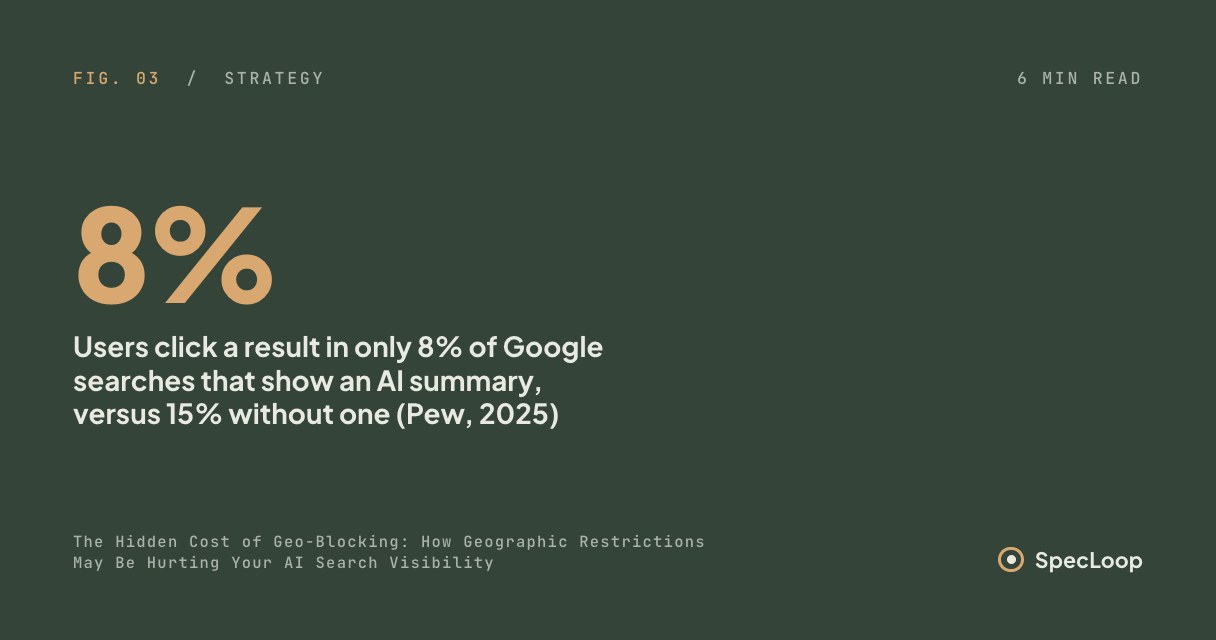
The Hidden Cost of Geo-Blocking: How Geographic Restrictions May Be Hurting Your AI Search Visibility
A 2025 White Paper on Generative Engine Optimization and the Evolution of Search
GEO & AI Search
How to Build a Site Fully Optimized for GEO in 2026
A lot of people have been asking how to build websites that AI search engines actually cite. This is the complete playbook, from architecture decisions to structured data to content strategy, for making your site a primary source in ChatGPT, Perplexity, Google AI Overviews, and every generative engine that matters.
Strategy
Why We're Moving Our Clients Off WordPress
We still maintain dozens of WordPress sites. Here's the honest operator view from inside the stack, what changed, why we're migrating our own book of business to custom native sites, and how we do it without breaking anything.
Strategy
Why a Custom Native AI Site Beats WordPress and Rented Platforms in the New Google Era
Google's AI Overviews now appear on nearly half of all searches and are cutting organic traffic 20–40%. Here's why rebuilding on a custom native site is the only durable answer for security, speed, and AI visibility.
Next step
Want a spec for your build?
We write the full specification before any code is generated, then ship in 30–60 days at one flat rate. You own every line.