GEO & AI Search//8 min read/Jason Gordon
How to Build a Site Fully Optimized for GEO in 2026
A lot of people have been asking how to build websites that AI search engines actually cite. This is the complete playbook, from architecture decisions to structured data to content strategy, for making your site a primary source in ChatGPT, Perplexity, Google AI Overviews, and every generative engine that matters.
GEO Is Not SEO With a New Name
Let's get this out of the way: Generative Engine Optimization is not just "SEO for AI." Traditional SEO optimizes for ranking in a list of ten blue links. GEO optimizes for being cited, quoted, or referenced inside an AI-generated answer. The mechanics are fundamentally different.
When someone asks ChatGPT "What's the best way to build a custom business app?", the answer doesn't come from a ranked list. It comes from content the model has ingested, structured data it can parse, and real-time retrieval from sites it can crawl. Your goal in GEO is to be the source that gets pulled into that answer.
The Core Shift
In SEO, you compete for position. In GEO, you compete for citation. The winner isn't the site that ranks #1, it's the site whose content gets quoted inside the AI's response.
The AI Crawler Landscape in 2026
Before you optimize anything, you need to understand who's crawling your site. AI systems use dedicated crawlers that behave differently from traditional search bots. Blocking or ignoring them means your content never enters the AI's knowledge base.
| Crawler | Operator | What It Feeds | robots.txt Directive |
|---|---|---|---|
| GPTBot | OpenAI | ChatGPT, GPT-5, SearchGPT | User-agent: GPTBot |
| PerplexityBot | Perplexity AI | Perplexity search answers | User-agent: PerplexityBot |
| ClaudeBot | Anthropic | Claude web search | User-agent: ClaudeBot |
| Google-Extended | Gemini, AI Overviews | User-agent: Google-Extended | |
| Applebot-Extended | Apple | Apple Intelligence, Siri | User-agent: Applebot-Extended |
| FirecrawlBot | Firecrawl / Various | Third-party AI apps | User-agent: FirecrawlBot |
Check Your robots.txt Right Now
Many sites still block AI crawlers by default, either through overly restrictive robots.txt rules or WAF geo-blocking that inadvertently blocks US-based AI crawler IPs. Run a crawl audit before anything else.
Architecture: Build for Crawlability First
AI crawlers are not browsers. They don't execute JavaScript. They don't wait for client-side hydration. They don't interact with SPAs. If your content only exists after React mounts and an API call completes, AI crawlers see an empty page.
- Use server-side rendering (SSR) or static site generation (SSG) for all content pages
- Include a comprehensive
- Ensure every page has a complete HTML with meta title, description, and canonical URL
- Generate a full XML sitemap covering every indexable URL, not just your top 30 pages
- Implement proper internal linking so crawlers discover deep content without relying on navigation JS
- Keep page load times under 2 seconds, slow responses cause AI crawlers to abandon the page
What We Do at SpecLoop
Every site we build includes a pre-rendered
Structured Data: The Language AI Engines Actually Read
Structured data (JSON-LD) is no longer optional. It's the primary way AI engines extract facts, pricing, processes, and relationships from your site. Without it, AI systems have to guess what your content means. With it, they can quote you accurately.
Here are the Schema.org types that matter most for GEO:
| Schema Type | What It Tells AI | Best For |
|---|---|---|
| Organization | Company name, description, services, contact info | Homepage, About page |
| Product / Service | What you sell, pricing, features | Product pages, pricing pages |
| HowTo | Step-by-step processes with clear instructions | Tutorials, guides, documentation |
| FAQPage | Question-answer pairs on specific topics | FAQ sections, support pages |
| Article / BlogPosting | Author, publish date, topic, word count | Blog posts, whitepapers, case studies |
| BreadcrumbList | Site hierarchy and page relationships | Every page (navigation context) |
| Review / AggregateRating | Social proof and quality signals | Product pages, case studies |
The key insight: AI engines use structured data to validate claims made in your body content. If your text says "we build apps for $7,500" and your Product schema says the same thing, the AI has higher confidence in citing that fact. Consistency between structured data and page content is critical.
Content Strategy: Write for Citation, Not Just Ranking
GEO-optimized content is structurally different from SEO content. SEO content is written to match search queries and keep users on-page. GEO content is written to be quotable, to contain clear, factual, well-attributed statements that an AI can extract and present as an answer.
The Anatomy of Citable Content
- Lead with a clear, factual claim in the first 2-3 sentences of each section
- Include specific numbers, percentages, and timeframes: AI engines love quantifiable statements
- Use entity-rich language: name specific tools, platforms, standards, and methodologies
- Structure content with clear H2/H3 headings that match natural language questions
- Add "definition" paragraphs that start with "X is..." or "X refers to...", these get quoted verbatim
- Include comparison tables: AI engines extract tabular data more reliably than prose
- Cite your own research with methodology notes: AI engines weight sourced claims higher
The sites that win at GEO aren't the ones with the most content. They're the ones with the most quotable content, clear statements of fact, backed by data, structured for extraction.
Jason Gordon, SpecLoop
Technical Implementation Checklist
Here's the exact technical checklist we follow for every site we build at SpecLoop. This is the same process we used to optimize specloop.ai for AI search visibility.
- 60+: URLs in Sitemap
- 7: JSON-LD Schema Types
- 100%: Pages with Meta Tags
- 0: AI Crawlers Blocked
1. robots.txt Configuration
Your robots.txt should explicitly allow every major AI crawler. Don't rely on defaults, some hosting platforms and CDNs block AI bots by default. Here's what a GEO-optimized robots.txt looks like:
- Allow GPTBot, PerplexityBot, ClaudeBot, Google-Extended, Applebot-Extended explicitly
- Point to your XML sitemap with a Sitemap: directive
- Block only admin routes, API endpoints, and auth pages
- Test with each crawler's user-agent string to verify access
2. Meta Tags and Open Graph
Every page needs a unique, descriptive
- Set max-image-preview:large and max-snippet:-1 in robots meta tags
- Include Open Graph tags (og:title, og:description, og:image) for social and AI preview cards
- Add canonical URLs to prevent duplicate content confusion
- Use descriptive, keyword-rich alt text on all images
3. Internal Linking Architecture
AI crawlers follow links to discover content, just like Googlebot. But they're less patient, they crawl fewer pages per session. Your internal linking needs to surface your most important content within 2-3 clicks of the homepage.
- Link from your homepage to every major content hub (blog, docs, resources, pricing)
- Cross-link related blog posts and guides within body content
- Include a comprehensive HTML sitemap page that links to every public URL
- Use descriptive anchor text, "our 30-day development process" beats "click here"
Measuring GEO Performance
Traditional SEO metrics (rankings, organic traffic, CTR) don't fully capture GEO performance. You need new signals to understand whether AI engines are finding and citing your content.
| Metric | What It Measures | How to Track |
|---|---|---|
| AI Crawler Hits | How often AI bots crawl your pages | Server logs filtered by GPTBot, PerplexityBot, etc. |
| Citation Rate | How often AI engines quote your content | Manual testing + tools like Otterly.ai or GEO tracking platforms |
| Referral Traffic | Visitors arriving from AI engines | GA4 filtered by referral source (chat.openai.com, perplexity.ai) |
| Schema Validation | Whether your structured data is error-free | Google Rich Results Test, Schema.org validator |
| Content Freshness | How recently your key pages were updated | CMS/sitemap lastmod dates |
Pro Tip
Set up a monthly "AI citation audit", ask ChatGPT, Perplexity, and Gemini the questions your customers ask you most. Check whether your site gets cited. If not, analyze the sources that do get cited and reverse-engineer their content structure.
Common GEO Mistakes to Avoid
- Blocking AI crawlers in robots.txt, you lose all AI search visibility overnight
- Relying on client-side rendering without SSR/SSG fallbacks: AI crawlers see empty pages
- Thin, generic content that makes no specific claims, nothing for AI to quote
- Missing structured data: AI engines can't extract facts reliably from unstructured prose alone
- Geo-blocking or WAF rules that inadvertently block AI crawler IP ranges (mostly US-based)
- Ignoring AI referral traffic in analytics, you can't optimize what you don't measure
- Over-optimizing for one AI engine, diversify across ChatGPT, Perplexity, Gemini, and Claude
- Treating GEO as a one-time project: AI models retrain regularly; keep content fresh
The SpecLoop GEO Stack
Every site we build at SpecLoop is GEO-optimized out of the box. Here's what's included in our standard build:
-
Pre-rendered
-
Comprehensive XML sitemap with all 60+ public URLs and lastmod dates
-
JSON-LD structured data: Organization, Product, HowTo, FAQPage, BlogPosting, BreadcrumbList
-
robots.txt explicitly allowing GPTBot, PerplexityBot, ClaudeBot, Google-Extended, and Applebot-Extended
-
Unique meta titles (<60 chars) and descriptions (<160 chars) on every page
-
Open Graph and Twitter Card tags for social and AI preview optimization
-
max-image-preview:large and max-snippet:-1 for rich AI previews
-
Server-side og-meta edge function for dynamic social sharing previews
-
Internal linking architecture with descriptive anchor text
-
Monthly AI citation audits and content freshness updates
-
$7,500: Starting Price (GEO-Optimized Site)
-
30 Days: Delivery Timeline
-
100%: Code Ownership
-
30 Days: Post-Launch Support
Bottom Line
GEO in 2026 is not a nice-to-have, it's a competitive necessity. As more users get answers directly from AI rather than clicking through search results, the sites that get cited in those answers will capture the lion's share of trust, traffic, and conversions.
The good news: the fundamentals aren't complicated. Allow AI crawlers. Use structured data. Write quotable content. Measure your citation rate. Do these consistently and you'll outperform 90% of sites that are still optimizing exclusively for traditional search.
Want a Site Built for AI Search From Day One?
Every site we build at SpecLoop is fully GEO-optimized, structured data, AI crawler access, quotable content architecture, and citation tracking included. Let's build yours.
Calculate Your ROI Schedule Discovery Call
Sources & References
- OpenAI GPTBot Documentation - platform.openai.com/docs/gptbot
- Google Search Central: AI Overviews - developers.google.com/search/docs/appearance/ai-overviews
- Perplexity AI Crawler Documentation - docs.perplexity.ai/docs/resources/perplexity-crawlers
- Schema.org Structured Data Reference - schema.org/docs/schemas.html
- SpecLoop GEO Research: Geo-Blocking Impact Study - specloop.ai/resources/hidden-cost-geo-blocking-ai-search-visibility
- SpecLoop GEO Guide: Complete 2025 Strategy - specloop.ai/resources/generative-engine-optimization-complete-guide-2025
Get insights like this in your inbox
Join SpecLoop Insider for weekly deep-dives on custom software, AI, and operational efficiency. No fluff.
Subscribe
Frequently asked
Questions people ask about this
- Semantic HTML, complete Schema.org markup, fast edge delivery, and content structured as claim + evidence + source. AI crawlers ingest structure differently than Google's classic crawler, clean markup translates directly into higher citation rates.
About the author
Jason Gordon
Founder, SpecLoop
Jason Gordon is the founder of SpecLoop, a spec-driven AI development studio that builds production-grade business applications from a complete specification, in weeks, at flat rate, with 100% code ownership. He also builds GeoTest, a free tool that scores how visible a site is to AI search engines. He writes about AI search, spec-driven development, and why most AI builds never reach production.
Keep reading
Related posts
GEO & AI Search
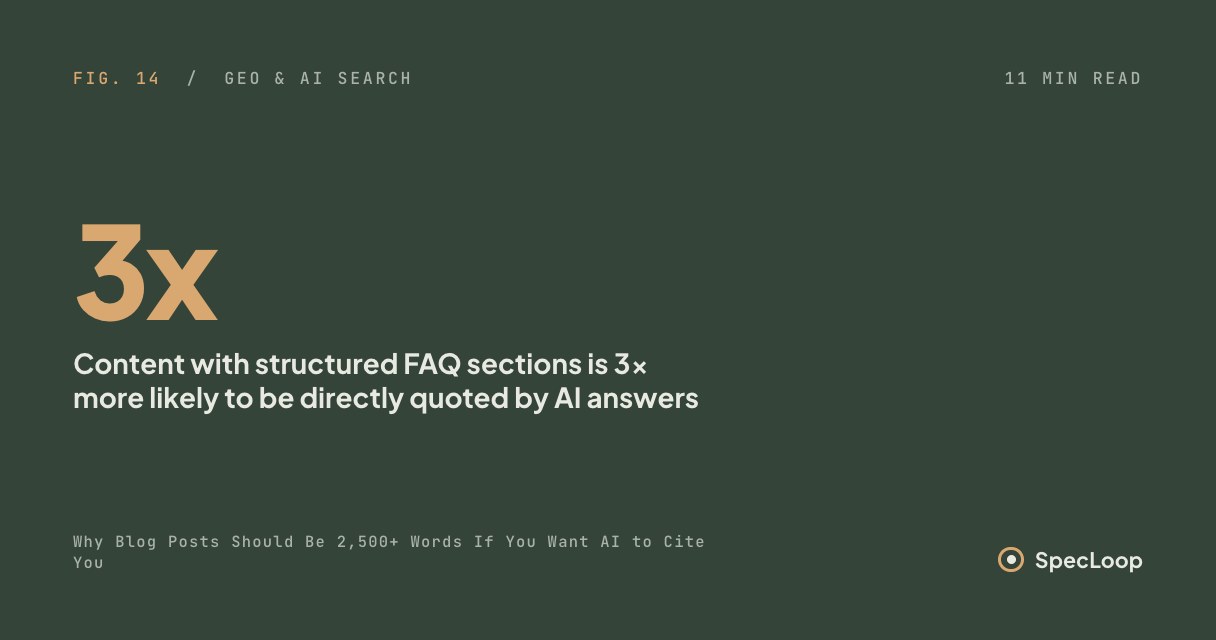
Why Blog Posts Should Be 2,500+ Words If You Want AI to Cite You
A lot of people have been asking us why we recommend long-form content for every client's blog strategy. The short answer: AI search engines don't cite thin content. Here's the full breakdown, the data, the mechanics, and the framework for getting your content quoted by ChatGPT, Perplexity, and Google AI Overviews.

GEO & AI Search
The New SEO: How to Rank in ChatGPT, Gemini, and Perplexity in 2026
AI assistants now answer millions of queries every day without sending users to a single website. If your brand isn't being cited inside those answers, you're invisible to a rapidly growing share of your buyers. Here's how AI search actually works, and exactly how to earn citations across every platform that matters.
GEO & AI Search
Google Just Killed the Search Box: What I/O 2026 Means for Every Business With a Website
Five days ago at Google I/O 2026, Google announced the biggest change to Search in 25 years, the search bar is being replaced by AI agents. If your website was built to rank on a results page that no longer exists, you have a problem. Here's what changed, why it matters, and what to do this quarter.
AI Development
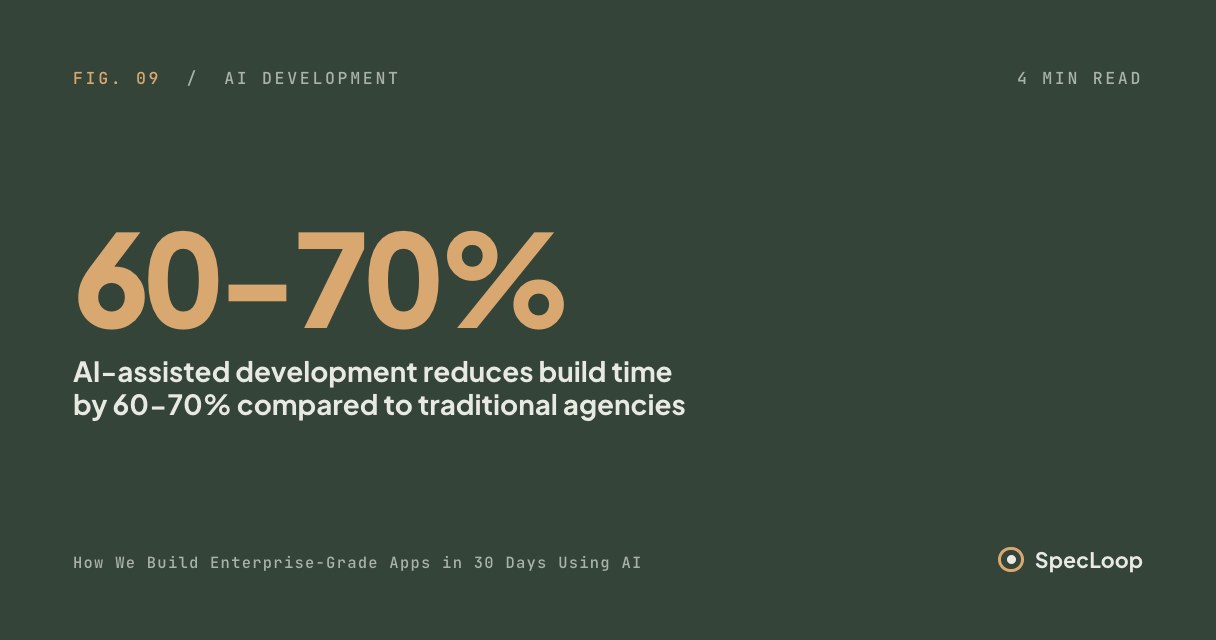
How We Build Enterprise-Grade Apps in 30 Days Using AI
A lot of people have been asking how we ship production-ready, full-stack business applications in 30 days at a flat rate. Here's exactly how our AI-powered development process works, and why it delivers enterprise-grade results faster than traditional agencies.
Next step
Want a spec for your build?
We write the full specification before any code is generated, then ship in 30–60 days at one flat rate. You own every line.