GEO & AI Search//10 min read/Jason Gordon
Google Just Killed the Search Box: What I/O 2026 Means for Every Business With a Website
Five days ago at Google I/O 2026, Google announced the biggest change to Search in 25 years, the search bar is being replaced by AI agents. If your website was built to rank on a results page that no longer exists, you have a problem. Here's what changed, why it matters, and what to do this quarter.
What Actually Happened at Google I/O 2026
On May 19, 2026, Google CEO Sundar Pichai opened I/O with a single message: Search is being rebuilt around AI agents. The classic search box, the thin white rectangle that has defined the web since 2001, was officially redesigned for the first time in over 25 years into a new, intelligent, AI-powered Search box that accepts complex multi-step questions and triggers agents on your behalf.
Here is what Google announced, in plain language:
- A redesigned, AI-powered Search box. Google formally retired the old "type a few keywords, get blue links" paradigm. The new box accepts complex, multi-step questions ("Plan a 4-day trip to Lisbon for a family of four under $3,000, including flights and a hotel near the water") and routes them to Gemini-powered agents.
- AI Mode and AI Overviews become the default surface. The synthesized answer at the top of the page is now the answer for most queries. Blue links are demoted below the fold.
- Information Agents, always-on AI that works while you sleep. Announced as "the next evolution of Google Alerts," these agents monitor topics around the clock and push synthesized updates to you. Rolling out this summer to Google AI Pro and Ultra subscribers in the US.
- Agents that perform tasks, not just retrieve links. Search can now research, compare, summarize, book, and (in some categories) complete purchases without the user ever leaving the result.
- Visual and voice agents replace typing. Lens, Live, and voice surfaces now handle a growing share of queries, none of which involve a typed keyword.
The Verge called it "Google Search's biggest changes ever." VentureBeat: "Google just redesigned the search box for the first time in 25 years, here's why it matters more than you think." Google's own framing in the official blog post: "A new era for AI Search."
Why This Is the Biggest Announcement From Google in 25 Years
Every major Google update before this one, Panda, Penguin, BERT, Helpful Content, even AI Overviews, changed how Google ranked websites. This update changes whether websites are the destination at all.
In the old model, Google's value was sending you to a page. Your website was the product. SEO was a competition for ranking positions on a results page, and traffic was the prize. In the new model, Google's value is giving you the answer. Your website is the raw material. GEO (Generative Engine Optimization) is a competition for being cited inside an answer, and visibility is the prize.
| Dimension | Old Google (2001–2025) | New Google (I/O 2026 onward) |
|---|---|---|
| Primary interface | Search bar with text input | Conversational AI agent |
| Result format | 10 ranked blue links | Synthesized answer with citations |
| Success metric | Ranking position + CTR | AI citation rate + brand mention frequency |
| User intent | Find a site to visit | Get an answer or complete a task |
| Optimization unit | Page targeting a keyword | Extractable, semantic content blocks |
| Winning content | Long-form pages stuffed with target terms | Direct answers, structured data, depth across topic cluster |
The implication for businesses
If you spent the last decade investing in SEO, that investment is not worthless, but it is no longer sufficient. The websites that win in 2026 are the ones engineered for AI retrieval and citation, not just keyword ranking.
What This Means for Your Website Right Now
The data on what happens when AI takes over search results is no longer speculative. Multiple independent data sources have been tracking this for the past 12 months, and the pattern is clear.
Chartbeat, which tracks traffic across more than 2,500 publisher websites, found that Google search referral traffic is already down 33% globally and 38% in the US, measured year-over-year before Google I/O even happened. The impact scales inversely with size: publishers with fewer than 10,000 daily pageviews have seen a 60% drop, mid-sized operations are down 47%, and even large publishers are down 22%.
Similarweb's data on zero-click searches tells the structural story. Zero-click searches, where a user types a query and never clicks a single result, rose from 56% to 69% between May 2024 and May 2025. When Google's AI Overviews appear on a results page, 83% of searches end without a click. In Google's newer AI Mode, that number reaches 93%. A Pew Research Center study of 68,000 real search queries found that users clicked on results 8% of the time when an AI summary appeared, compared to 15% without one, a 47% decline in click probability from a single UI change.
The businesses most exposed are those answering questions AI can fully synthesize: definitions, comparisons, how-tos, product specs, and local recommendations. These categories are losing click traffic fastest, and the I/O 2026 announcements extend that dynamic across nearly every query type.
Sites that publish thin, keyword-targeted pages are being skipped entirely, the AI cannot extract a clean answer from them, so they are not cited. Sites with deep, structured, semantically organized content are being cited more often, even when their Google ranking is lower than competitors. Brand mentions in third-party sources (Reddit, LinkedIn, Wikipedia, industry publications, podcast transcripts) are now a stronger predictor of AI citation than backlinks.
If your site was built more than two or three years ago, there is a very high probability that none of those signals are working in your favor. The site was built for a search experience that no longer exists.
The Five Things a Modern Website Has to Do in 2026
A GEO-native website, the kind that gets cited inside AI agent answers, has five non-negotiable properties. We use these as the architectural baseline for every new SpecLoop build.
1. Answer-First Content Architecture
Every important page leads with a direct answer to the question it claims to address, in a short, extractable paragraph. The supporting analysis comes after. AI agents extract the first clean answer they can find. If your page buries the lede under three paragraphs of brand storytelling, it loses the citation.
2. Semantic HTML and Structured Data
Headings, lists, tables, FAQ blocks, and JSON-LD schema (Organization, Article, FAQPage, Product, HowTo, Person) make content machine-readable. Agents do not guess at structure, they parse it. A page with clean semantic structure and rich schema is dramatically more likely to be cited than the same content rendered as a wall of divs.
3. Topical Depth, Not Just Topical Coverage
AI agents prefer sources that demonstrate authority across a topic cluster. A site with 30 well-organized, interlinked articles answering every meaningful question in a niche will out-cite a site with one viral post. Our GEO standard for client sites is 2,500+ word pillar articles plus a cluster of supporting pieces, the same pattern that earns AI citations across ChatGPT, Gemini, and Perplexity.
4. Fast, Server-Rendered, Agent-Friendly Delivery
Most agent crawlers do not execute JavaScript well, or at all. Sites that ship content via client-side rendering, hide content behind modals, or rely on slow third-party scripts get partial or empty extractions. Modern GEO-native sites are server-rendered or pre-rendered, edge-deployed, and load in under a second on a cold cache.
5. Off-Site Brand Presence
Your own site is necessary but not sufficient. Agents weight sources based on how often your brand, founders, products, and signature concepts appear across the wider web. Earning mentions in Reddit threads, LinkedIn posts, industry publications, podcast transcripts, and Wikipedia is now part of the website strategy, not a separate marketing channel.
Why This Is Actually a Massive Opportunity (If You Move Fast)
Every major platform shift in the last 20 years, the move to mobile, the rise of social, the launch of Google Maps, the App Store, produced two groups of businesses: the ones who adapted in the first 12 months and dominated the next decade, and the ones who waited and never recovered.
AI search is the same shift, compressed into a shorter window. The brands that get cited inside AI agent answers in the next 90–180 days will become the default sources the models continue to retrieve from. Gartner has projected a 25% drop in overall search volume by 2026 driven by AI substitution, and Google's I/O 2026 announcements suggest that projection may be conservative. By the time the laggards rebuild, the citation graph will already be set.
The opportunity for mid-market businesses is unusually large here. Most enterprises move too slowly to rebuild a corporate site in a quarter. Most small businesses do not have the resources to engineer for GEO from scratch. The middle of the market, companies doing $2M–$100M in revenue, can move quickly, ship a modern site, and own the citation share in their category before competitors notice the rules changed.
The Bottom Line
Google did not tweak Search at I/O 2026. They replaced the front door of the internet. Every business that depends on being found online is now operating in a different game, with different rules, scored on different metrics.
The businesses that recognize this in May and June and rebuild around it before fall will own their category's AI citation share for years. The businesses that wait until they see the traffic drop will be rebuilding inside a citation graph that already has a winner, and it will not be them.
This is the rarest kind of moment in digital strategy: a window where the right answer is obvious, the work is doable in a quarter, and almost no one is moving yet. Move now.
A Practical 90-Day Plan for Any Business
You do not need a six-figure budget or a full rebuild to start. Here is the plan we are giving every client this month, in order:
Days 1–14: Audit and Diagnose
- Run your top 25 brand and category queries through ChatGPT, Gemini, Perplexity, and Google AI Overviews. Note which sources are cited. Note whether you are cited at all.
- Run your top 10 pages through a render test (View Page Source, then a JS-disabled view). If your content is not visible without JavaScript, agents may not see it either.
- Inventory your structured data. Most sites have none, or have schema markup that has not been touched in years.
- Map your topical coverage. Identify the 5–10 questions in your category that you have not answered in depth.
Days 15–45: Rebuild the Foundation
- Rewrite your top 10–20 pages around answer-first structure. Direct answer in the first paragraph, then supporting depth.
- Add or fix JSON-LD schema for Organization, Article, FAQPage, Product, and Person across the site.
- If your site relies heavily on client-side rendering, plan a move to server rendering or pre-rendering. This is often the single highest-ROI change.
- Publish 4–8 deep, 2,500+ word articles answering the questions you identified in the audit. Interlink aggressively.
Days 46–90: Earn Off-Site Authority
- Pitch and place 3–5 founder-authored pieces in industry publications. Unlinked mentions count.
- Show up in Reddit, LinkedIn, and category-specific forums with substantive answers under your real name.
- Get your founders, products, and signature concepts cited by name in podcasts, newsletters, and analyst notes.
- Update Wikipedia and Wikidata where legitimately appropriate (and where your category has presence).
- Re-run the same 25 queries from Day 1 and measure citation share. You should see movement within 60–90 days of consistent effort.
The bar is lower than you think
Almost no one in the mid-market is doing this yet. The companies that complete even half of this 90-day plan will out-perform 90% of their category in AI citation share by the end of the quarter.
What SpecLoop Is Doing for Clients Right Now
Every active engagement is getting a free GEO re-audit, updated structured data, and a baseline AI citation report, at no cost, so we can measure the lift from this point forward. If you want us to run the same audit on your site, we offer it as a one-time engagement and apply the cost against a build if you decide to move forward.
Get a GEO-Native Site Built in 30–60 Days
SpecLoop ships enterprise-grade, AI-citation-ready websites and applications at flat rates starting at $5,000. 100% code ownership. 30–60 day delivery. Book a discovery call and we will run a free baseline AI citation report on your current site.
Book a Discovery Call See How We Work
Sources & References
- Google Blog: Google Search's I/O 2026 updates: AI agents and more - https://blog.google/products-and-platforms/products/search/search-io-2026/
- Google Blog: I/O 2026: Welcome to the agentic Gemini era (Sundar Pichai's keynote) - https://blog.google/innovation-and-ai/sundar-pichai-io-2026/
- Google Blog, 100 things we announced at Google I/O 2026 - https://blog.google/innovation-and-ai/technology/ai/google-io-2026-all-our-announcements/
- The Verge: Google Search is getting its biggest changes ever - https://www.theverge.com/tech/932970/google-search-ai-update-io-2026
- The Verge: The future of Google is a search box that does everything - https://www.theverge.com/tech/934217/google-search-box-does-everything-ai-io-2026
- VentureBeat: Google just redesigned the search box for the first time in 25 years - https://venturebeat.com/technology/google-just-redesigned-the-search-box-for-the-first-time-in-25-years-heres-why-it-matters-more-than-you-think
- The Next Web: Google launches always-on information agents in Search at I/O 2026 - https://thenextweb.com/news/google-wants-search-to-work-while-you-sleep-and-its-new-information-agents-are-the-plan
- Google I/O '26 Keynote (YouTube, 8.9M views) - https://www.youtube.com/watch?v=wYSncx9zLIU
- Chartbeat: Global publisher traffic data 2025–2026 (via AdExchanger, abit.ee) - https://abit.ee
- Similarweb: Zero-click search data May 2024–May 2025 (via Search Engine Journal, click-vision.com) - https://click-vision.com
- Pew Research Center: Study of 68,000 real search queries, AI summary click behavior - https://pewresearch.org
- Gartner: Search volume projections through 2026 - https://gartner.com
- ALM Corp / AdExchanger: AI Overviews 58% CTR reduction analysis - https://almcorp.com/blog/google-ai-overviews-publisher-traffic-decline-antitrust-lawsuit-analysis/
Get insights like this in your inbox
Join SpecLoop Insider for weekly deep-dives on custom software, AI, and operational efficiency. No fluff.
Subscribe
Frequently asked
Questions people ask about this
- Google announced the phased replacement of the classic search box with AI Mode as the default entry point. Traditional ten-blue-links results are becoming a fallback surface rather than the primary experience.
About the author
Jason Gordon
Founder, SpecLoop
Jason Gordon is the founder of SpecLoop, a spec-driven AI development studio that builds production-grade business applications from a complete specification, in weeks, at flat rate, with 100% code ownership. He also builds GeoTest, a free tool that scores how visible a site is to AI search engines. He writes about AI search, spec-driven development, and why most AI builds never reach production.
Keep reading
Related posts
GEO & AI Search
The New SEO: How to Rank in ChatGPT, Gemini, and Perplexity in 2026
AI assistants now answer millions of queries every day without sending users to a single website. If your brand isn't being cited inside those answers, you're invisible to a rapidly growing share of your buyers. Here's how AI search actually works, and exactly how to earn citations across every platform that matters.
GEO & AI Search
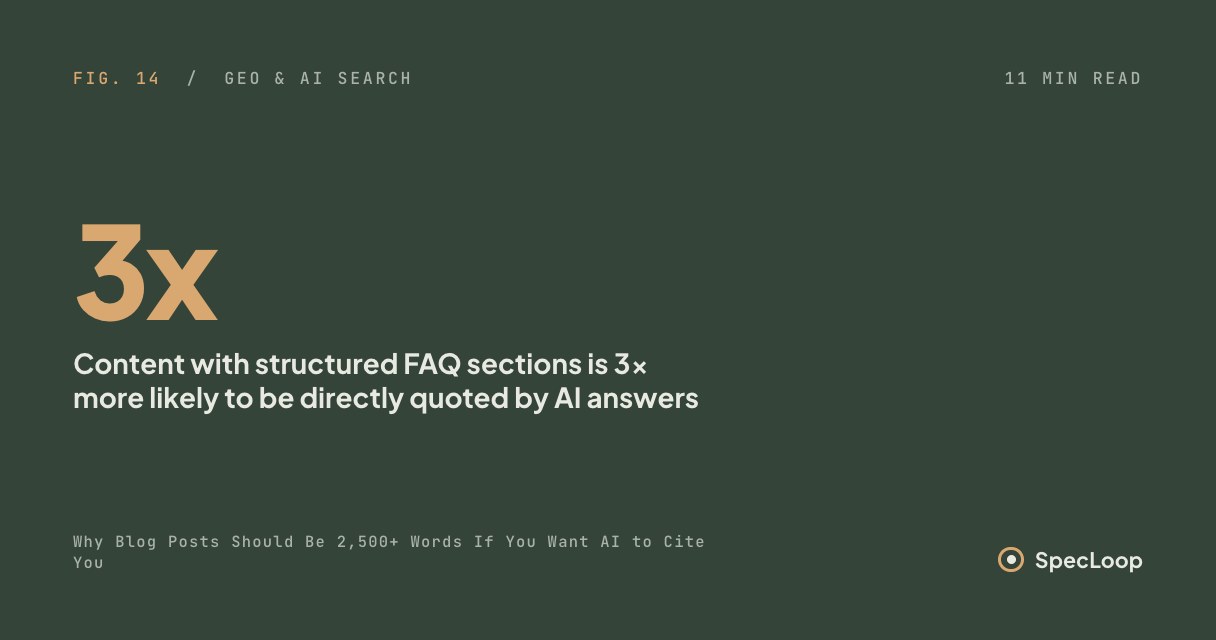
Why Blog Posts Should Be 2,500+ Words If You Want AI to Cite You
A lot of people have been asking us why we recommend long-form content for every client's blog strategy. The short answer: AI search engines don't cite thin content. Here's the full breakdown, the data, the mechanics, and the framework for getting your content quoted by ChatGPT, Perplexity, and Google AI Overviews.
GEO & AI Search
How to Build a Site Fully Optimized for GEO in 2026
A lot of people have been asking how to build websites that AI search engines actually cite. This is the complete playbook, from architecture decisions to structured data to content strategy, for making your site a primary source in ChatGPT, Perplexity, Google AI Overviews, and every generative engine that matters.
AI Development
How We Build Enterprise-Grade Apps in 30 Days Using AI
A lot of people have been asking how we ship production-ready, full-stack business applications in 30 days at a flat rate. Here's exactly how our AI-powered development process works, and why it delivers enterprise-grade results faster than traditional agencies.
Next step
Want a spec for your build?
We write the full specification before any code is generated, then ship in 30–60 days at one flat rate. You own every line.