GEO & AI Search//12 min read/Jason Gordon
The New SEO: How to Rank in ChatGPT, Gemini, and Perplexity in 2026
AI assistants now answer millions of queries every day without sending users to a single website. If your brand isn't being cited inside those answers, you're invisible to a rapidly growing share of your buyers. Here's how AI search actually works, and exactly how to earn citations across every platform that matters.
What Is AI Search and Why Does It Change Everything?
Traditional search works like a library index. You type a keyword, an algorithm matches it to pages that contain those words, and you get a ranked list of blue links. Visibility meant ranking on page one. Traffic meant clicks.
AI search works like a knowledgeable colleague. You ask a question, the system synthesizes an answer from multiple sources, and delivers a single, conversational response, often without you ever clicking a link. Visibility now means being cited inside the answer itself.
This distinction is critical. A brand can rank #1 on Google for a keyword and still have almost no presence in AI-generated responses for that same query. In fact, ranking #1 on Google gives you only a 31.4% AI mention rate, meaning nearly 70% of the time, the top Google result is not what AI platforms cite.
The Implication
Optimizing for traditional Google rankings is necessary, but no longer sufficient. AI search is a separate optimization problem with its own retrieval mechanics, authority signals, and success metrics.
How AI Search Algorithms Actually Work: Understanding RAG
To rank in AI search, you first need to understand the engine behind it. Most AI search platforms, including ChatGPT, Perplexity, and Google's AI Overviews, use a system called Retrieval-Augmented Generation (RAG).
RAG is a two-stage process. First, retrieval: the system searches the web (and sometimes its own indexed knowledge base) for documents relevant to the query, scores them for relevance, and assembles a shortlist of passages. Second, generation: a large language model takes those retrieved passages as context and synthesizes a new, original answer. It doesn't copy and paste, it rewrites and merges information from multiple sources into a single coherent response, then cites the sources it drew from.
Your content never appears verbatim in the AI's answer. What matters is whether the AI retrieved your page as a source and whether it could extract a clean, usable answer from your content.
| Stage | What Happens | Your Optimization Goal |
|---|---|---|
| Query Processing | User input is interpreted and broken into sub-queries | Answer the sub-questions within a topic, not just the top-level keyword |
| Retrieval | AI crawls the web and pulls relevant passages | Get retrieved: earn brand mentions, backlinks, structured content |
| Generation & Citation | AI synthesizes an answer and cites sources | Be usable: format content so AI can extract a clean, citable answer |
This pipeline means there are exactly two problems to solve: getting retrieved, and being usable once you are. Most brands focus on neither.
Part 1: How to Get Retrieved by AI Search Engines
Getting retrieved is a trust and authority problem. AI systems, like the humans who built them, are skeptical. They have access to the entire web. For your content to be pulled into an AI's retrieval pool, it needs to signal that it's credible, relevant, and worth citing.
1. Brand Mentions Now Outperform Backlinks
For decades, SEO was built on backlinks. The number and quality of sites linking to you was the primary signal of authority. That's still relevant for traditional Google rankings, but for AI search, brand mentions are a stronger predictor of AI visibility than backlinks.
Why? Because AI systems are trained on vast corpora of text from across the internet. When your brand, your founders, your products, or your ideas are mentioned repeatedly in high-quality sources, news articles, industry reports, academic papers, forums, podcast transcripts, the AI develops a prior belief that your brand is a credible source in your space.
An unlinked mention in a respected industry publication may do more for your AI search visibility than a dozen link-building campaigns.
- Pursue PR and editorial coverage, not just guest posts with links
- Get your brand name, key personnel, and signature concepts mentioned in industry conversations
- Create concepts, frameworks, or terms others will reference by name (e.g., "the [Brand] Method" or "[Brand]'s [Named Framework]")
- Show up in the sources AI systems already trust: major publications, .gov and .edu sites, well-trafficked industry forums
2. Establish Deep Topical Authority
AI systems don't just look at individual pages, they evaluate how comprehensively a site covers a subject. A website with 40 well-structured articles answering every meaningful question within a niche will consistently outrank a website with one viral post on the same topic.
When the AI is assembling sources for a complex query, it gravitates toward sources that have demonstrated expertise across the entire topic cluster.
- Map every meaningful question your audience asks within your niche
- Build content that answers those questions at every level, beginner, intermediate, advanced
- Interlink your content so AI crawlers can understand the breadth and depth of your expertise
- Update older content regularly, freshness signals matter to retrieval systems
3. Earn Presence on High-Authority Third-Party Platforms
Your own website is not the only place AI systems retrieve information from. Perplexity, ChatGPT, and Gemini routinely pull answers from Reddit threads, Quora answers, YouTube transcripts, Wikipedia, LinkedIn articles, podcast show notes, and major industry publications.
If you're only creating content on your own domain, you're limiting your retrieval surface. A well-written Reddit answer, a thoughtful LinkedIn post, or a detailed forum response can all become AI citation sources, and they carry the authority of the platform they're published on.
- Actively participate in forums and communities where your audience asks questions
- Post substantive long-form content on LinkedIn
- Ensure your YouTube video descriptions and transcripts contain the key answers from your videos
- Maintain an up-to-date Wikipedia page if your brand or category warrants one
4. Technical Accessibility for AI Crawlers
AI retrieval systems can only cite content they can actually read. Heavy JavaScript rendering, slow page loads, paywalls, login walls, and missing sitemaps all silently kill your retrieval rate.
Common Retrieval Killers
Content loaded only via client-side JavaScript, page loads slower than 2 seconds, content behind authentication, and missing or misconfigured robots.txt. Make sure your highest-value pages are clean HTML, fast, and explicitly crawlable by GPTBot, PerplexityBot, ClaudeBot, and Google-Extended.
Part 2: How to Make Your Content Usable for AI
Getting retrieved is only half the battle. Once an AI system pulls your page into its candidate pool, it needs to be able to extract a clean, specific answer from your content. If your page is a wall of rambling paragraphs with no clear structure, the AI will skip to a competitor that answered the same question more clearly.
1. Answer the Question Directly at the Top
AI systems are optimized for efficiency. They are looking for the answer, and they're looking for it fast. The most effective structure for AI-citable content is the same structure used in legal briefs and encyclopedias: state the answer first, then explain it.
Instead of building to a conclusion through five paragraphs of context, lead with the conclusion. Then explain the nuance, the caveats, and the supporting evidence below. This is called the "inverted pyramid" structure in journalism. In AI search, it's a citation magnet.
Inverted Pyramid Example
Not AI-friendly: "When thinking about content strategy in the modern landscape, there are many factors to consider…", AI-friendly: "The most important factor in content strategy for AI search is topical authority, the breadth and depth of coverage across a specific subject area. Here's why that matters and how to build it."
2. Use Clear, Semantic Structure
AI language models are excellent at understanding structure. Headers, bullet points, numbered lists, and tables make it dramatically easier for an AI to extract a specific piece of information and use it as a citation.
- Use descriptive H2 and H3 headers that contain the actual question or topic (not clever, vague titles)
- Use bullet points and numbered lists for steps, features, comparisons, or any multi-part answer
- Use tables for comparisons, specs, and data: AI systems are particularly good at extracting tabular data
- Use bold text to highlight the key claim in each section
- Keep paragraphs short, 2 to 4 sentences is ideal; walls of text reduce extractability
3. Write for the Specific Sub-Question, Not Just the Main Keyword
When a user asks an AI a question, the AI doesn't just run a single search. It often breaks the query down into multiple sub-queries, retrieves sources for each, and synthesizes the results.
Your content needs to answer not just the headline question but the five to ten sub-questions that surround it. A comprehensive, specific answer to a narrow sub-question is often more valuable than a vague, general answer to a broad topic. For example, if your primary topic is "AI content strategy," your content should also directly answer:
- What is the difference between GEO and SEO?
- How does RAG affect content creation?
- What content formats does Perplexity cite most?
- How often should AI-optimized content be updated?
- Does content structure affect AI citation rates?
4. Include Specific, Citable Facts and Data
AI systems strongly prefer content that contains specific, verifiable facts over vague generalities. A claim like "AI search is growing fast" is not very citable. A claim like "56% of global search traffic now flows through AI assistants, according to a 2026 Search Engine Land study" is highly citable.
- Statistics with sources
- Named studies or research papers
- Specific percentages, dollar amounts, timeframes
- Named frameworks or methodologies
- Clear, quotable definitions of concepts
5. Optimize for Zero-Click Readiness
In AI search, the user may get a complete, satisfying answer without ever visiting your website. This is uncomfortable for marketers trained to optimize for clicks, but it's the reality of the medium.
Design your content to provide value even when read only in excerpt form. Write summaries, definitions, and key takeaways that can stand alone. A user who gets value from your content inside an AI response is still building awareness and trust in your brand, even if they never click. Zero-click presence is the new top-of-funnel.
Part 3: Your Buyers Are Searching Everywhere: So Should You Be
One of the most important mindset shifts in AI search optimization is understanding that your audience is no longer using a single platform. In 2026, buyers search across multiple AI surfaces, and each one weights authority signals differently.
| Platform | Primary Use Case | Optimization Priority |
|---|---|---|
| ChatGPT | Conversational research and recommendations | Brand mentions, training-data presence, structured answers |
| Google Gemini / AI Overviews | Embedded in the world's most-used search engine | Traditional SEO + structured data + Google-Extended access |
| Perplexity | Deep research with cited sources | Crawlability, freshness, citation-friendly structure |
| Claude | Document analysis and nuanced Q&A | Long-form authority content and clear factual claims |
| Copilot (Microsoft) | Enterprise users in Microsoft 365 | Bing visibility and indexed knowledge sources |
| Social AI (TikTok, Instagram, LinkedIn) | In-app AI-assisted search results | Native long-form content and platform-specific authority |
Your goal is omni-channel citation presence, being the brand that gets mentioned and cited regardless of which AI platform your buyer happens to be using.
AI Search vs. Traditional SEO: Key Differences
| Factor | Traditional SEO | AI Search (GEO) |
|---|---|---|
| Primary Goal | Rank on page 1 | Get cited in AI answers |
| Top Authority Signal | Backlinks | Brand mentions + topical authority |
| Content Structure Priority | Keyword density, meta tags | Answer clarity, extractability |
| Traffic Model | Click-based | Citation-based (zero-click) |
| Platform | Primarily Google | ChatGPT, Gemini, Perplexity, Claude, Copilot |
| Content Freshness | Important | Critical: AI systems update frequently |
| Success Metric | Rankings, organic traffic | AI mention rate, citation frequency |
How to Audit Your Current AI Search Visibility
Before building a strategy, you need a baseline. Here's a simple five-step audit process.
- Step 1: Test your current AI mention rate. Search your primary keywords and brand name across ChatGPT, Perplexity, and Google AI Overviews. Note whether your brand appears in the generated answers, and whether competitors are being cited instead.
- Step 2: Analyze what is being cited. When AI platforms cite sources in your category, what types of content are they pulling? Long-form guides? Data reports? News articles? This tells you what formats perform best in your niche.
- Step 3: Evaluate your content's extractability. Read your top pages as if you were an AI trying to pull a clean answer. Is the answer stated clearly at the top? Are there clear headers? Is the page structured around specific questions?
- Step 4: Audit your brand mentions. Search your brand name in quotation marks across Google News, Reddit, LinkedIn, and YouTube. How frequently is your brand being mentioned by others? In what context?
- Step 5: Benchmark against competitors. Run the same AI mention tests for your top three competitors. Which brands appear most frequently in AI answers? What content of theirs is being cited? This is your competitive gap analysis.
Action Plan: 30-Day AI Search Optimization Sprint
Week 1: Foundation
- Conduct a full AI visibility audit across ChatGPT, Perplexity, and Google AI Overviews
- Identify the 10 most important questions your buyers are asking AI platforms
- Audit your top 10 pages for answer clarity and extractability
Week 2: Content Restructuring
- Rewrite underperforming pages to lead with direct answers
- Add structured headers that mirror the actual questions users ask
- Insert comparison tables and bullet-point summaries into key pages
- Add specific statistics and citable data to every major claim
Week 3: Brand Mention Building
- Identify 5 high-authority publications in your niche and pitch for editorial coverage
- Post substantive long-form content on LinkedIn and relevant forums
- Ensure your YouTube video descriptions contain the key answers from each video
- Activate a PR effort focused on unlinked brand mentions, not just backlinks
Week 4: Expansion and Monitoring
- Set up monitoring to track when your brand is mentioned in AI responses
- Expand content to cover adjacent sub-topics that increase your topical authority footprint
- Review and update your three highest-traffic pages with fresh data and current examples
The Bottom Line
The rules of search have changed. AI platforms are now a primary discovery channel for buyers across every industry, and they follow fundamentally different rules than the Google-first strategies that worked for the past decade.
The brands that will win in AI search are the ones that understand retrieval and create content AI systems want to pull into their source pool, build brand authority through genuine mentions and editorial coverage, structure for extractability so retrieved content delivers a clean citable answer, and think omni-channel, optimizing not just for Google but for every platform their buyers are using.
This is not about abandoning traditional SEO. It's about expanding your strategy to match where search is actually happening in 2026. Start with the audit. Restructure your best content for AI extractability. Build brand mentions alongside backlinks. And show up, consistently, credibly, across every platform, because your buyers are already there.
Want Your Site Engineered to Be Cited by AI?
Every site we build at SpecLoop is GEO-native: RAG-friendly architecture, structured data, brand-authority signals, and AI citation tracking included. Let's build yours.
Calculate Your ROI Schedule Discovery Call
Sources & References
- 2026 Search Engine Land: Global AI Search Traffic Study - searchengineland.com
- OpenAI GPTBot Documentation - platform.openai.com/docs/gptbot
- Perplexity AI Crawler Documentation - docs.perplexity.ai/docs/resources/perplexity-crawlers
- Google Search Central: AI Overviews - developers.google.com/search/docs/appearance/ai-overviews
- Anthropic Claude Web Search - anthropic.com
- SpecLoop: How to Build a Site Fully Optimized for GEO in 2026 - specloop.ai/resources/geo-site-optimization-2026
- SpecLoop: Why Blog Posts Should Be 2,500+ Words for AI - specloop.ai/resources/why-blog-posts-need-2500-words
- Inspired by Neil Patel, "The New SEO: How to Rank in ChatGPT and Google Gemini" - neilpatel.com
Get insights like this in your inbox
Join SpecLoop Insider for weekly deep-dives on custom software, AI, and operational efficiency. No fluff.
Subscribe
Frequently asked
Questions people ask about this
- SEO (Search Engine Optimization) focuses on ranking content in traditional search engine results pages, primarily Google, through keyword optimization and backlink building. GEO (Generative Engine Optimization) focuses on getting content cited inside AI-generated answers on platforms like ChatGPT, Gemini, and Perplexity. GEO prioritizes content extractability, brand authority, and topical depth over traditional keyword metrics.
About the author
Jason Gordon
Founder, SpecLoop
Jason Gordon is the founder of SpecLoop, a spec-driven AI development studio that builds production-grade business applications from a complete specification, in weeks, at flat rate, with 100% code ownership. He also builds GeoTest, a free tool that scores how visible a site is to AI search engines. He writes about AI search, spec-driven development, and why most AI builds never reach production.
Keep reading
Related posts
GEO & AI Search
Google Just Killed the Search Box: What I/O 2026 Means for Every Business With a Website
Five days ago at Google I/O 2026, Google announced the biggest change to Search in 25 years, the search bar is being replaced by AI agents. If your website was built to rank on a results page that no longer exists, you have a problem. Here's what changed, why it matters, and what to do this quarter.
GEO & AI Search
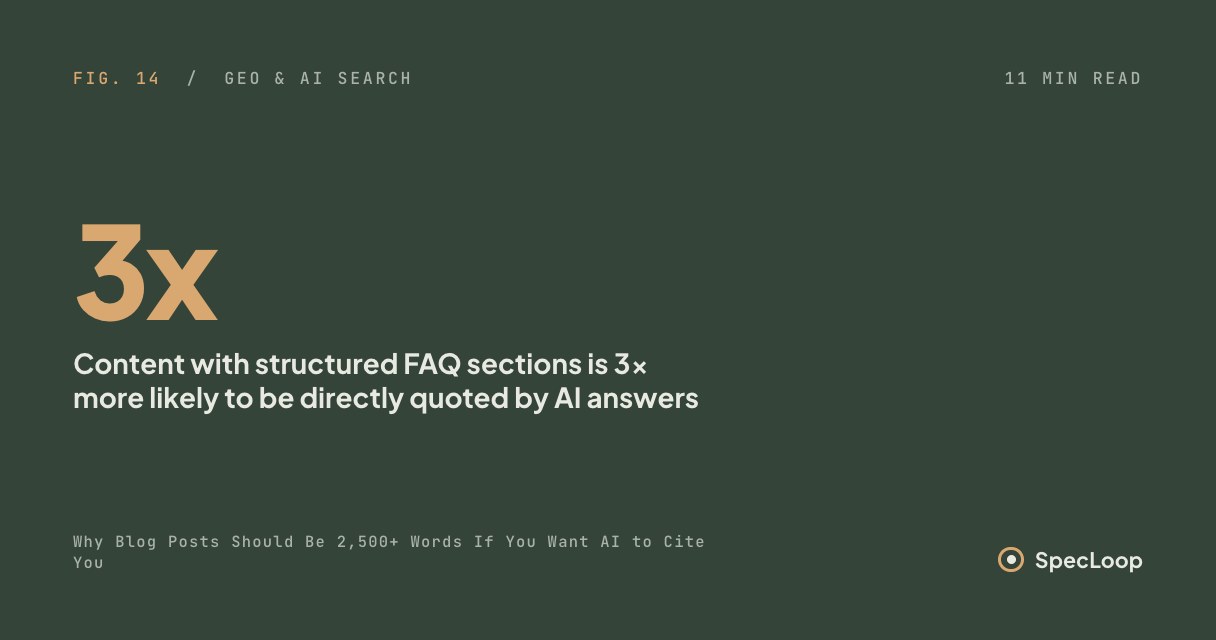
Why Blog Posts Should Be 2,500+ Words If You Want AI to Cite You
A lot of people have been asking us why we recommend long-form content for every client's blog strategy. The short answer: AI search engines don't cite thin content. Here's the full breakdown, the data, the mechanics, and the framework for getting your content quoted by ChatGPT, Perplexity, and Google AI Overviews.
GEO & AI Search
How to Build a Site Fully Optimized for GEO in 2026
A lot of people have been asking how to build websites that AI search engines actually cite. This is the complete playbook, from architecture decisions to structured data to content strategy, for making your site a primary source in ChatGPT, Perplexity, Google AI Overviews, and every generative engine that matters.
Strategy
Why We're Migrating Our Own WordPress Clients to Custom Native Sites in 2026
We still maintain dozens of WordPress sites. Here's the honest operator view from inside the stack, what changed in 2026, why we're moving clients off, and how we're doing it without burning the platform that served them well for a decade.
Next step
Want a spec for your build?
We write the full specification before any code is generated, then ship in 30–60 days at one flat rate. You own every line.