The Question That Started Everything
A common request in web development today sounds straightforward: "Can you help us block traffic from certain countries? We're getting hammered with spam form submissions, and it's becoming unmanageable."
This is a question many business owners ask. They're frustrated with fake leads, bot traffic, and security concerns that appear to originate from specific geographic regions. The traditional response has been simple: block those countries and move on.
Critical Discovery
But as research into this topic deepens, something fundamental becomes clear. The emergence of AI-powered search engines and Generative Engine Optimization (GEO) has created a new reality where geo-blocking might actually hurt businesses more than it helps them.
The Search Landscape Has Fundamentally Changed
Beyond Google: The Rise of AI Search
While we've all been focused on optimizing for Google's traditional search results, a quiet revolution has been taking place. AI-powered search engines and features are rapidly changing how people find information:
ChatGPT
100M+
searches per day
Google AI Overviews
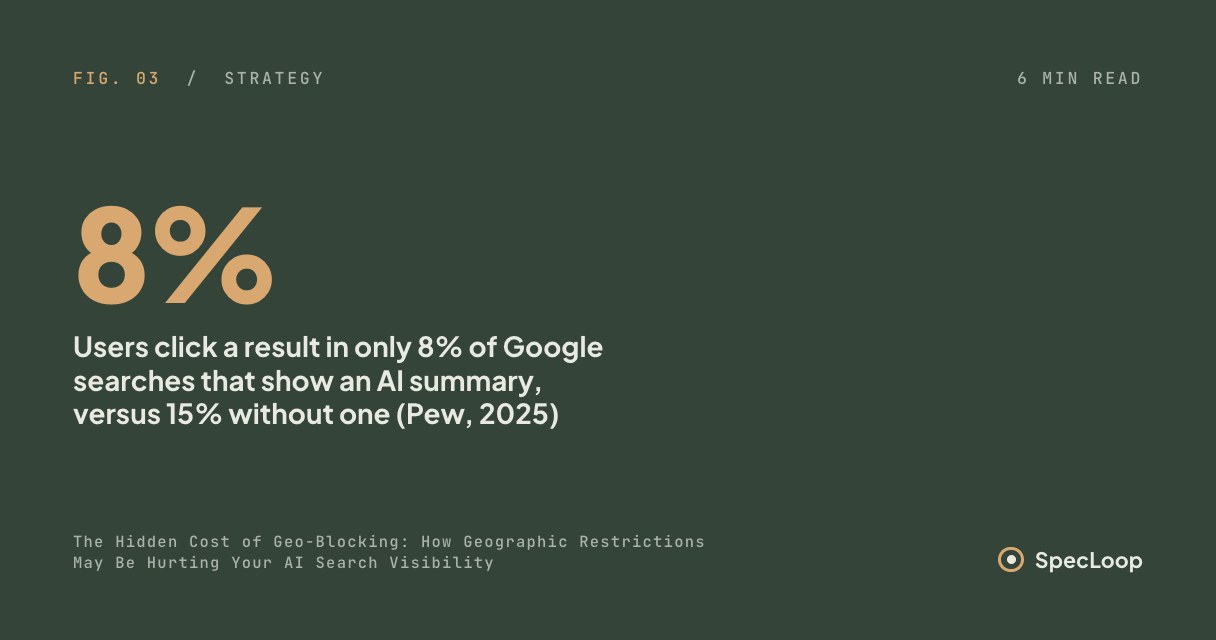
- 15%, of all search results
Perplexity AI
- Publishes its crawler IP ranges; blocked by most US-wide geo rules
Microsoft Copilot
Full
ecosystem integration
Here's the critical insight: these AI systems learn about your business by crawling your website. If they can't access your content, your business essentially doesn't exist in their knowledge base.
What Is Generative Engine Optimization (GEO)?
Traditional SEO focused on ranking in search results. GEO focuses on being cited and referenced in AI-generated answers. When someone asks ChatGPT or Google's AI about your industry, product, or service, you want your business to be part of that response.
The challenge? Most AI crawlers originate from the same IP ranges that businesses have been blocking to prevent spam.
The Hidden Cost of Geographic Blocking
The AI Crawler Reality Check
The crawler documentation from OpenAI, Anthropic, Perplexity and Google all point to the same fact: the major AI crawlers operate from published, US-hosted IP ranges. This includes:
- GPTBot (OpenAI's ChatGPT): ClaudeBot (Anthropic's Claude)
- Google-Extended (Google's AI training): OAI-SearchBot (OpenAI's search features)
If you're blocking traffic from the US or using broad geographic restrictions, you're likely blocking the very systems that will determine your future search visibility.
The Compounding Effect
When AI systems can't crawl your website, several things happen:
1. Training Data Exclusion
Your business isn't included in the foundational knowledge these systems use
2. Citation Invisibility
- You won't be referenced in AI-generated answers about your industry, 3
Competitive Disadvantage
- Competitors with accessible websites gain authority and visibility, 4
Future-Proofing Failure
As AI search grows, your digital presence shrinks
What Google Actually Says About Geo-Blocking
The Technical Truth
Google's official position on geo-blocking remains clear: it's not inherently against their guidelines if implemented correctly. The key principle is consistency, if you block human users from a country, you must also block Googlebot from that same country.
However, implementation errors are catastrophic. Businesses have accidentally blocked Googlebot entirely, resulting in complete deindexing and traffic losses of 80% or more.
The Infrastructure Reality
Google has significantly expanded their crawling infrastructure beyond the US. While 99% of crawling still originates from US-based data centers, Googlebot now operates from 11+ countries including India, Singapore, Netherlands, and Australia. This expansion means geo-blocking requires constant monitoring and updates, something most businesses aren't equipped to handle properly.
Better Solutions for the Spam Problem
Modern Spam Prevention That Actually Works
The good news? The spam problem that drives most geo-blocking decisions can be solved more effectively with modern tools that don't impact search visibility:
Intelligent Filtering Systems
- Akismet: 99.99% accuracy with zero geographical restrictions
- Advanced honeypots: Invisible to humans, obvious to bots
- Machine learning detection: Identifies patterns without blocking entire regions
User-Friendly Security
- Cloudflare Turnstile: CAPTCHA replacement with zero user friction
- Behavioral analysis: Detects bot patterns without geographic assumptions
- Progressive challenges: Escalates security only when suspicious behavior is detected
Performance and Cost Benefits
These modern solutions often outperform geo-blocking while costing less:
Higher accuracy
99%+
vs. the collateral damage of a country-level block
Better user experience
Zero
legitimate users blocked
Lower maintenance
- No need, to constantly update IP lists
SEO-friendly
Full
crawlability maintained
The Strategic Shift: From Blocking to Intelligence
Embracing Selective Accessibility
Rather than broad geographic blocking, successful businesses in 2025 are implementing intelligent accessibility strategies:
- Bot intelligence: allow verified search engine and AI crawlers while blocking malicious bots
- Behavioral filtering: focus on actions and patterns rather than geography
- Progressive security: start permissive and escalate only when necessary
- Content strategy: optimize for both traditional search and AI citation
Practical Recommendations
If You're Currently Using Geo-Blocking
Immediate Actions:
- 1.Audit your current restrictions: Document what you're blocking and why
- 2.Whitelist AI crawlers: Ensure GPTBot, ClaudeBot, and Google-Extended have access
- 3.Implement modern spam prevention: Deploy Akismet or similar intelligent filtering
- 4.Monitor performance: Watch for changes in search visibility and lead quality
Medium-term Strategy:
- 1.Phase out geographic restrictions: Gradually remove blocks while monitoring spam levels
- 2.Optimize for AI citation: Structure content to be easily referenced by AI systems
- 3.Implement comprehensive monitoring: Track both traditional SEO and AI visibility metrics
If You're Starting Fresh
Build with AI in Mind:
- 1.Choose CDN-level security: Cloudflare and similar services offer bot management without geographic restrictions
- 2.Implement progressive security: Start open, escalate when needed
- 3.Focus on content quality: AI systems prefer authoritative, well-structured content
- 4.Monitor AI mentions: Track when and how AI systems reference your business
The Future of Search Visibility
Preparing for an AI-First World
The businesses that will thrive in the coming years are those that:
🌐
Embrace accessibility
- Make content available to both human users and AI systems, 🎯
Focus on authority
- Build expertise that AI systems want to cite, 🛡️
Implement intelligent security
- Prevent abuse without limiting legitimate access, 📈
Monitor emerging trends
Stay ahead of new AI developments and requirements
The Cost of Waiting
Every day that AI systems can't access your content is a day your competitors gain ground in the new search landscape. The businesses implementing GEO strategies now will have significant advantages as AI search continues to grow.
Conclusion: Access Is the New Optimization
What started as a simple question about blocking spam has revealed a fundamental shift in how businesses need to think about website accessibility. The traditional approach of geographic blocking, while seemingly logical for security concerns, now carries hidden costs that many businesses don't realize.
Research indicates a concerning trend among businesses with geo-blocking enabled: many have experienced significant declines in organic traffic over recent months. This observation is one of the key drivers behind conducting this research, as businesses explore reversing their geo-blocking implementations.
In 2025, accessibility is optimization.
The businesses that make their content easily discoverable by AI systems while using intelligent tools to prevent abuse will have significant advantages in the new search landscape.
The evidence is clear: modern spam prevention tools consistently outperform geographic blocking in both effectiveness and user experience, while avoiding the AI visibility penalties that come with broad access restrictions. Meanwhile, the rapid growth of AI-powered search means that every day your content remains inaccessible to these systems is a day your competitors gain ground in future search results.
As we move into an AI-first world, the question isn't whether to block or allow access, it's how to be smart about both security and visibility. The future belongs to businesses that can solve the spam problem without sacrificing their place in the AI-powered search results of tomorrow.
The choice is yours: continue with outdated blocking strategies that may be limiting your digital growth, or embrace the intelligent accessibility approach that positions your business for success in the age of AI search.
Sources & References
- 1.: Google Search Central Documentation
developers.google.com/search/docs/specialty/international/locale-adaptive-pages
- 2.: Search Engine Journal
searchenginejournal.com/google-if-blocking-a-countrys-traffic-dont-block-googlebot/402127/
- 3.: Andreessen Horowitz
a16z.com/geo-over-seo/
- 4.: Cloudflare Turnstile
cloudflare.com/application-services/products/turnstile/
- 5.: Aleyda Solis
aleydasolis.com/en/search-engine-optimization/seo-vs-geo-optimizing-for-traditional-vs-ai-search/
Additional sources: This research also incorporates data from PPC Land, Google Support, Search Engine Land, Cloudflare, Geotargetly, SearchNatural, Ipify, Indusface, Momentic Marketing, SEO.ai, and Google Developers documentation. Full citation list available upon request.
Sources & references
- OpenAI: Overview of OpenAI crawlers (GPTBot, OAI-SearchBot) and published IP ranges
- Anthropic: Does Anthropic crawl data from the web, and how can site owners block the crawler?
- Google Search Central: Google common crawlers, including Google-Extended
- Perplexity: Perplexity crawlers
- Cloudflare: Bot concepts
- Pew Research Center: Google users are less likely to click on links when an AI summary appears (July 2025)
Frequently asked
Questions people ask about this
- Traditional geo-blocking, often used to prevent spam and bot traffic from specific countries, is now inadvertently harming businesses' visibility in the evolving AI-powered search landscape. While effective against spam in the past, it blocks legitimate AI crawlers (like GPTBot, ClaudeBot, and Google-Extended) that primarily originate from US-based IP addresses. This means that by blocking certain geographic regions, businesses are preventing AI systems from accessing and learning about their content, leading to a significant "hidden cost" in terms of future search visibility.
About the author
Jason Gordon
Founder, SpecLoop
Jason Gordon is the founder of SpecLoop, a spec-driven AI development studio that builds production-grade business applications from a complete specification, in weeks, at flat rate, with 100% code ownership. He also builds GeoTest, a free tool that scores how visible a site is to AI search engines. He writes about AI search, spec-driven development, and why most AI builds never reach production.
Keep reading
Related posts
Strategy
Generative Engine Optimization (GEO): The Complete Guide to AI Search Visibility in 2025
A Strategic White Paper for Business Leaders - Master the transformation from traditional SEO to AI-powered search optimization

Strategy
The Agentic Coding Shift: Why Mid-Market Teams Are Building Custom Again
Agentic AI just collapsed the cost and timeline of custom software. The old "buy SaaS, don't build" rule was a response to economics that no longer exist. Here's why mid-market teams are quietly going back to custom, and what to build first.
Strategy
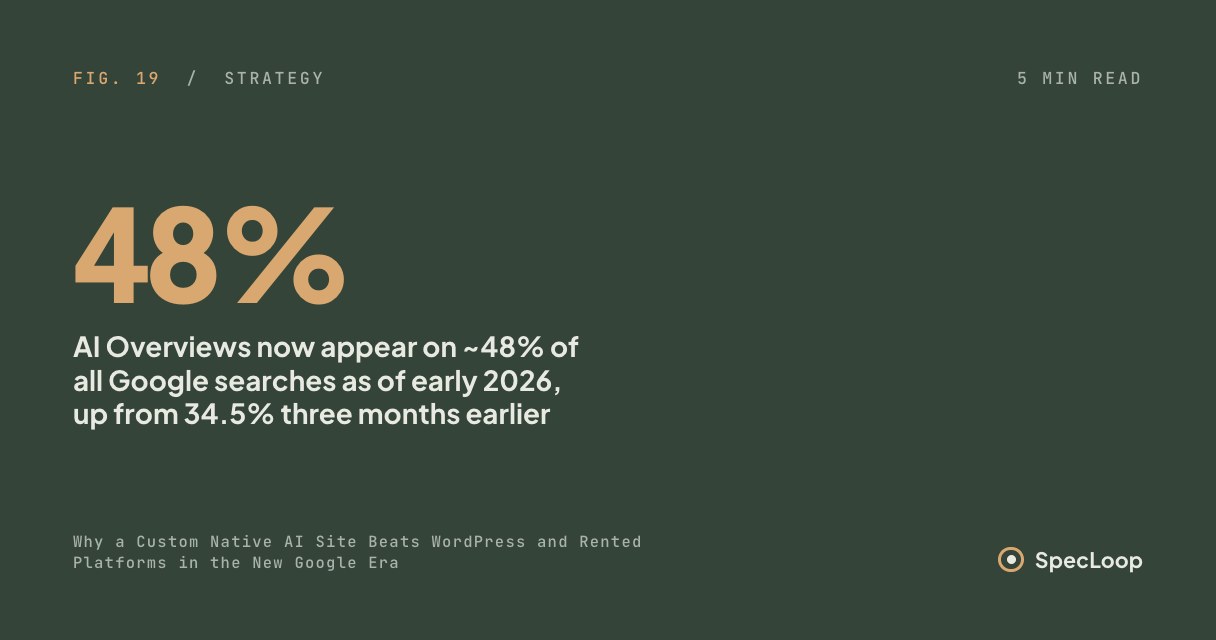
Why a Custom Native AI Site Beats WordPress and Rented Platforms in the New Google Era
Google's AI Overviews now appear on nearly half of all searches and are cutting organic traffic 20–40%. Here's why rebuilding on a custom native site is the only durable answer for security, speed, and AI visibility.
Strategy
Why We're Moving Our Clients Off WordPress
We still maintain dozens of WordPress sites. Here's the honest operator view from inside the stack, what changed, why we're migrating our own book of business to custom native sites, and how we do it without breaking anything.
Next step
Want a spec for your build?
We write the full specification before any code is generated, then ship in 30–60 days at one flat rate. You own every line.