Strategy//7 min read/Jason Gordon
The Agentic Coding Shift: Why Mid-Market Teams Are Building Custom Again
Agentic AI just collapsed the cost and timeline of custom software. The old "buy SaaS, don't build" rule was a response to economics that no longer exist. Here's why mid-market teams are quietly going back to custom, and what to build first.
What actually changed in the last 18 months
Three shifts compounded into something genuinely new. None of them, on their own, would have changed the buy-vs-build calculus. Together, they did.
The first is that the models got good enough to plan. Earlier AI coding tools were great at autocomplete and terrible at architecture. The current generation of agentic models can take a real product specification, decompose it into modules, write the code, run the tests, fix the failures, and ship a working feature without a human typing each line. They aren't autonomous, a senior engineer still drives, but the leverage ratio jumped from "helpful pair programmer" to "team of supervised juniors."
The second is that the agentic harnesses around the models matured. The discipline of running an AI coding agent in a sandboxed environment with linting, type checking, automated tests, and continuous review caught up with what production teams actually need. Anthropic's 2026 Agentic Coding Trends Report and the independent IBM and SoftServe/MIT studies all converge on the same number: well-run agentic teams ship 3–5x faster on greenfield work, and 40–50% faster on mature codebases, with comparable or better defect rates.
The third, and this one is underrated, is that the mid-market SaaS stack has gotten genuinely painful. A typical mid-sized operations team now pays for 40–80 SaaS products, runs Zapier and an iPaaS to glue them together, and burns real engineering hours on integration maintenance. The cost of owning the stack has crept up to the point where, in a lot of cases, a single well-built custom application would replace four or five SaaS subscriptions and pay for itself inside a year.
The buy-vs-build rule was an economic argument, not a moral one.
"Don't build, buy" was always the right call when custom software cost $500K and took a year. It was never about SaaS being inherently better, it was about custom being prohibitively expensive. Change one of those variables and the entire decision rule has to be re-derived.
What the new economics actually look like
It helps to put numbers on this rather than waving at it. Here is the comparison we walk mid-market clients through when they ask whether a custom build still makes sense:
| Dimension | Traditional custom build (pre-2024) | Agentic custom build (2026) | Mid-market SaaS stack (typical) |
|---|---|---|---|
| Time to first usable version | 6–12 months | 14–60 days | Instant, but workflow fits ~70% |
| Typical project cost | $300K–$1M+ | $15K–$75K | $0 upfront / recurring per-seat |
| 5-year cost of ownership (50 users) | $400K–$1.2M | $60K–$150K | $120K–$300K + integration tax |
| Code ownership | Usually shared with vendor | 100% to the client | None, you rent it |
| Workflow fit | Custom-fit | Custom-fit | 70% fit, 30% workaround |
| Integration burden | Built in | Built in | Ongoing Zapier/iPaaS overhead |
The headline number isn't the upfront cost. It's the five-year total. Once you stop paying per seat, the comparison stops being close.
Why mid-market specifically
Agentic coding helps everyone, solo founders, enterprise teams, agencies. But it changes the strategic picture most dramatically for the mid-market, and that's worth saying clearly.
Enterprises have always built custom software because they can absorb the cost. Solo founders and small shops have always lived on SaaS because they have no other option. The mid-market, companies with 50 to 1,000 employees, real operational complexity, and budgets that are serious but finite, was the segment that bought SaaS not because it fit, but because building didn't pencil out. That's the segment whose decision rule just inverted.
A 200-person operations team paying $8 per seat per month for a workflow tool that does 70% of what they need is now in a position to fund a custom replacement that does 100% of what they need, in 30 days, for less than a year of those subscription fees. That's not a marginal improvement. That's a different category of decision.
What to build first (and what not to)
We don't tell clients to rip out their entire SaaS stack. That's the wrong frame. The right frame is to find the one or two systems where the workaround tax has gotten heavy enough to justify a purpose-built replacement, build those, and let the rest of the stack keep doing what it does.
The systems that almost always justify a custom build in 2026:
- Internal operations tools your team has built a shadow workflow around in Excel, Notion, and shared inboxes, the SaaS doesn't fit, and the team has voted with their feet
- Customer-facing portals where the off-the-shelf solution forces a generic experience and you're losing differentiation
- Quote, proposal, or pricing systems that combine your unique business rules with data from three or four other systems
- Anything where you're paying for an enterprise plan to unlock a feature you'd build in a weekend with an agentic team
- Anything that requires moving data between five SaaS tools and where the integration layer is more fragile than the products themselves
The systems that almost never justify a custom build, even in 2026:
- Email, calendar, video conferencing, and core productivity: Google or Microsoft already won, don't fight that
- General-purpose CRM at the small end (under ~25 sales seats): HubSpot or Pipedrive at their lower tiers is genuinely good value
- Accounting and payroll, the regulatory surface area alone makes custom a bad bet for most companies
- Anything where compliance, audit, and regulator-recognized vendor status matter more than workflow fit
How we actually run an agentic build
I want to demystify this part, because "AI builds it" is the kind of phrase that does more to obscure the work than describe it. Here is what an agentic build actually looks like inside our team.
- A senior engineer owns the spec, what the system does, who uses it, what it integrates with, what the edge cases are
- The spec is decomposed into modules and the AI agent generates a first working version of each module under that senior's direction
- Every change runs through automated tests, type checking, and a human code review, nothing ships unreviewed
- The client sees a working version of the system within days, not months, and gives feedback against something real instead of a wireframe
- Iteration is measured in hours instead of sprints, the cost of a change drops by roughly the same ratio as the cost of the initial build
The senior engineer is still essential. The agent is a force multiplier, not a replacement. What changes is the ratio of senior time required per shipped feature, and that ratio is what moved the economics.
The honest caveats
I'd rather flag the failure modes now than have you discover them. Agentic builds done badly produce some of the worst codebases I've ever seen, unmaintainable, undocumented, full of subtle bugs the agent confidently introduced. The teams that get this right share a few habits:
- They put a senior engineer in the driver's seat on every project, every time, no "AI-only" delivery
- They invest in the harness, tests, type checking, linting, CI, before they accelerate output, because acceleration without those guardrails is just faster damage
- They treat AI-generated code as code, not magic, it gets reviewed, refactored, and owned exactly like human-written code
- They keep the architecture decisions human and the implementation work agent-assisted, the opposite of the failure pattern
Done well, agentic builds produce cleaner, more consistent codebases than traditional teams under deadline pressure, because the agent doesn't take shortcuts when it's tired at 11pm on a Thursday. Done badly, they produce technical debt at machine speed. The difference is supervision.
What this means for the next 24 months
The mid-market companies that are going to come out of this period ahead are not the ones replacing their entire stack with custom code. They're the ones surgically replacing the two or three SaaS systems where workflow fit matters most, capturing the margin and the differentiation that creates, and letting the rest of the stack ride.
The companies that are going to fall behind are the ones still operating under a 2019 buy-vs-build heuristic, paying integration tax to glue together tools that don't quite fit, and assuming custom software is still slow and expensive. The economics they're optimizing for stopped existing two years ago.
If you're a mid-market operator and you've felt for a while that your SaaS stack is working against you more than for you, your instinct is right. The reason it's gotten worse isn't that the tools got worse, it's that the alternative got dramatically better, and the gap is now visible from inside your monthly P&L.
Find Out What's Worth Building Custom
We'll do a free assessment of your current SaaS stack and identify the one or two systems where a purpose-built replacement would pay for itself inside 12 months. No pitch, just a straight read.
Calculate Your Build vs Buy ROI Talk to Us
Closing thought
Custom software has had a credibility problem for a generation because, frankly, it deserved one. It was too expensive, too slow, and too often delivered something the team wouldn't use. Agentic coding didn't fix every one of those problems, it fixed the two that mattered most, and that's enough to put custom back on the table for companies that wrote it off a decade ago.
The buy-vs-build debate isn't dead. The version of it from 2019 is. The new version is sharper, more interesting, and a lot more in the operator's favor than it has been in a very long time.
Sources & References
- Anthropic, 2026 Agentic Coding Trends Report - anthropic.com/research
- IBM: Productivity gains from agentic AI in software engineering (Bob study) - ibm.com/research
- SoftServe & MIT: Engineering leadership survey on agentic AI adoption, 2026 - softserveinc.com/insights
- Stack Overflow: Developer Survey 2026 (AI tooling section) - survey.stackoverflow.co
- Gartner: Mid-Market SaaS Spend Benchmarks 2026 - gartner.com
Get insights like this in your inbox
Join SpecLoop Insider for weekly deep-dives on custom software, AI, and operational efficiency. No fluff.
Subscribe
Frequently asked
Questions people ask about this
- Agentic coding uses AI systems that can plan, write, run, and debug multi-file code changes end-to-end. Autocomplete only suggests the next few lines. Agentic tools like Claude Code and Cursor can implement whole features against a spec, which is what collapses custom software timelines from months to days.
About the author
Jason Gordon
Founder, SpecLoop
Jason Gordon is the founder of SpecLoop, a spec-driven AI development studio that builds production-grade business applications from a complete specification, in weeks, at flat rate, with 100% code ownership. He also builds GeoTest, a free tool that scores how visible a site is to AI search engines. He writes about AI search, spec-driven development, and why most AI builds never reach production.
Keep reading
Related posts
Strategy
Why We're Moving Our Clients Off WordPress
We still maintain dozens of WordPress sites. Here's the honest operator view from inside the stack, what changed, why we're migrating our own book of business to custom native sites, and how we do it without breaking anything.
Engineering
Vibe Coding Is Not Engineering: The QA Gap That's Costing Mid-Market Teams Their Reputation
AI agents can now generate full applications from a prompt. But the difference between a demo that impresses on Twitter and software that runs a business is testing, architecture, and operational discipline. Here's the line most teams are missing.
Strategy
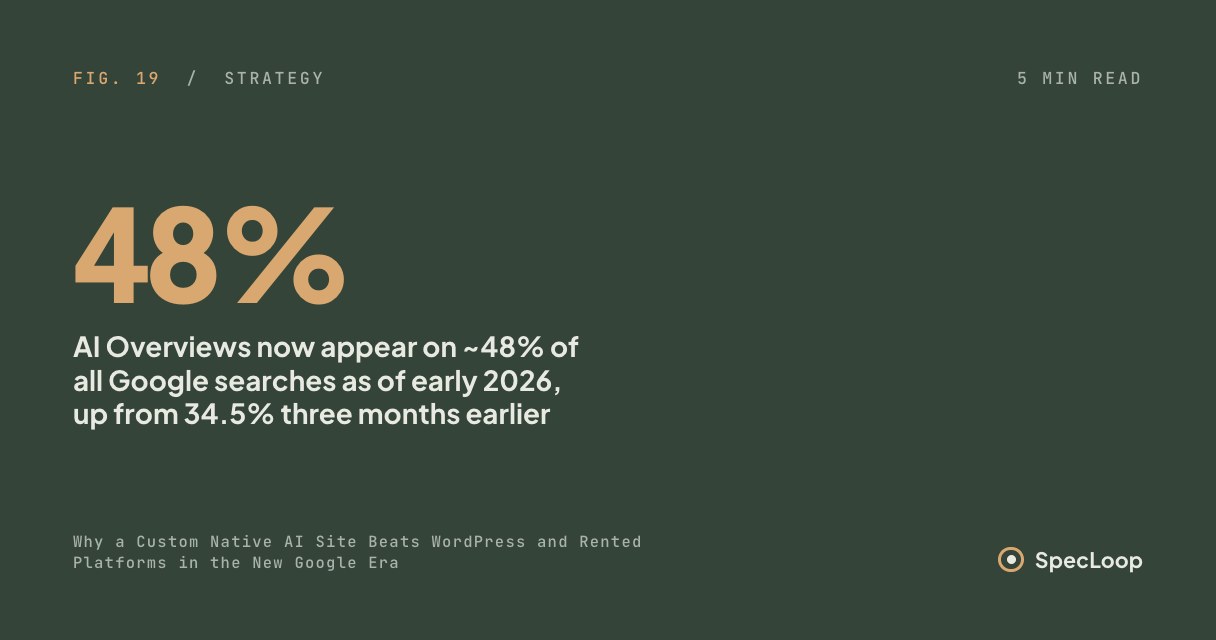
Why a Custom Native AI Site Beats WordPress and Rented Platforms in the New Google Era
Google's AI Overviews now appear on nearly half of all searches and are cutting organic traffic 20–40%. Here's why rebuilding on a custom native site is the only durable answer for security, speed, and AI visibility.
Strategy
Why We're Migrating Our Own WordPress Clients to Custom Native Sites in 2026
We still maintain dozens of WordPress sites. Here's the honest operator view from inside the stack, what changed in 2026, why we're moving clients off, and how we're doing it without burning the platform that served them well for a decade.
Next step
Want a spec for your build?
We write the full specification before any code is generated, then ship in 30–60 days at one flat rate. You own every line.