Business Strategy//5 min read/Jason Gordon
Custom Apps vs SaaS: The Real Cost of Renting Software You Don't Own
A lot of business owners have been asking us whether it makes more sense to keep paying monthly SaaS subscriptions or invest in custom-built software they own. We ran the numbers. The answer might surprise you.
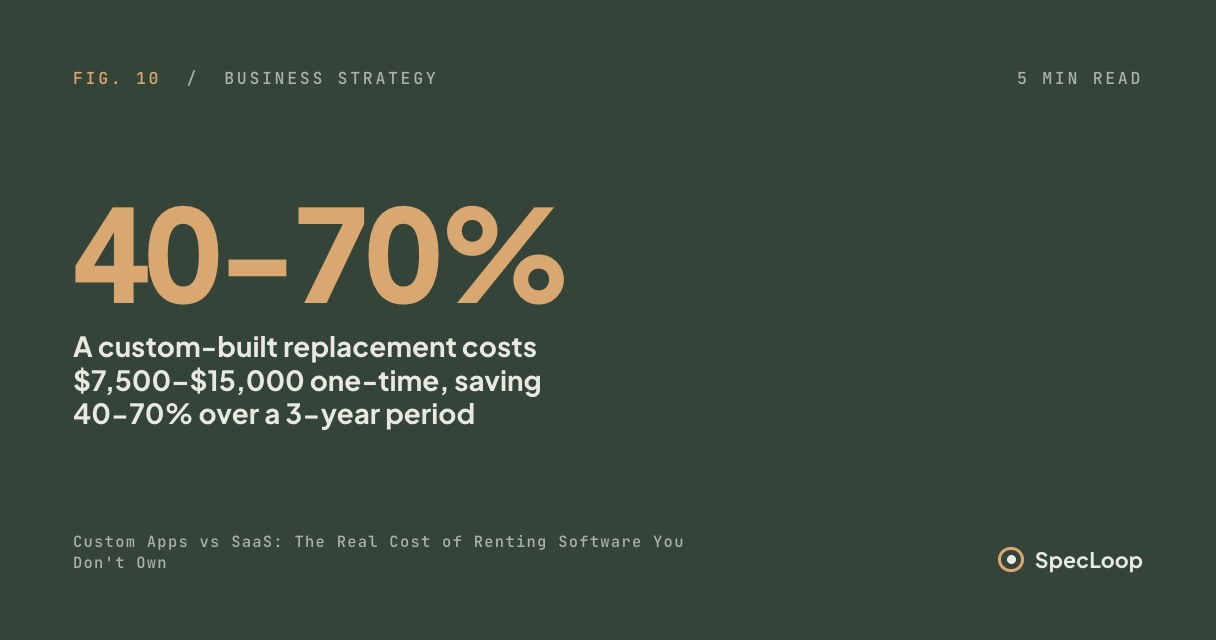
The SaaS Trap: How Monthly Fees Compound Into a Fortune
SaaS was revolutionary when it started. Instead of buying expensive enterprise software licenses, you could pay $50/month and get started immediately. But that was 2010. In 2026, the average mid-size business is paying $2,000–$5,000/month across multiple SaaS subscriptions, and they don't own any of it.
That's rent. You're renting software. And like rent, those payments never stop, the landlord can raise the price whenever they want, and you build zero equity.
| The rent | |
|---|---|
| Average monthly SaaS spend | $2K–$5K |
| 3-year total cost | $72K–$180K |
| Equity built | 0% |
Months of Payments
The Real TCO: SaaS vs Custom
Let's break this down with real numbers. We'll compare a typical SaaS stack against a custom-built alternative over 3 years.
Scenario: Growing Services Business (15 employees)
| Tool Category | SaaS Monthly Cost | SaaS 3-Year Total |
|---|---|---|
| CRM (Salesforce/HubSpot) | $750/mo | $27,000 |
| Project Management (Monday.com) | $400/mo | $14,400 |
| Accounting (QuickBooks + add-ons) | $300/mo | $10,800 |
| Marketing (Mailchimp + tools) | $350/mo | $12,600 |
| Internal Tools (Airtable + Zapier) | $200/mo | $7,200 |
| Total SaaS | $2,000/mo | $72,000 |
Custom Alternative: One Unified Platform
| Item | Cost | Recurring? |
|---|---|---|
| Custom Business App (Standard) | $7,500 | One-time |
| Additional Modules (CRM + Finance) | $5,000 | One-time |
| Hosting & Maintenance | $250/mo | Monthly |
| Year 1 Total | $15,500 | , |
| 3-Year Total | $21,500 | , |
3-Year Savings: $50,500
That's a 70% reduction in total cost of ownership. And after 3 years, the custom app keeps running for just $250/month in hosting, while the SaaS bills keep compounding.
The Hidden Costs of SaaS Nobody Talks About
1. Per-Seat Pricing Punishes Growth
Most SaaS tools charge per user per month. When you hire 5 more people, your software costs jump by $500–$1,000/month. Custom software? Add as many users as you want, the cost doesn't change.
2. Feature Creep Tax
SaaS products add features constantly, and raise prices to match. Salesforce has raised prices 3 times in the last 5 years. You're paying for AI features, analytics dashboards, and integrations you never asked for.
3. Data Hostage Situation
Try exporting your data from Salesforce. Or migrating your email sequences from HubSpot. Or moving your projects from Monday.com. The export is always incomplete, the formats are proprietary, and the migration costs $20K–$50K in consulting fees.
Vendor Lock-In Is Real
When your business data lives in a vendor's system, you're locked in. Switching costs are designed to be prohibitively expensive. Custom software stores your data in your own database, you can query it, export it, or migrate it anytime.
4. Workflow Friction
SaaS tools are built for everyone, which means they're optimized for no one. Your team wastes hours clicking through menus designed for generic use cases. Custom software is built for your exact workflow, every click matters, every screen is relevant.
5. Integration Tax
Connecting SaaS tools together costs extra. Zapier ($50–$200/mo), middleware ($100–$500/mo), custom connectors ($5K–$15K). A custom platform has integrations built in, no middleware required.
When SaaS Still Makes Sense
We're not saying SaaS is always wrong. It makes sense in specific situations:
- You need something immediately and can't wait 30 days (but consider: is the SaaS tool really production-ready in a day either?)
- The tool solves a commodity problem perfectly (email delivery with SendGrid, payments with Stripe)
- Your team is under 5 people and your workflows are simple
- You need a tool for a short-term project (under 6 months)
For core business operations that you'll run for years? Custom software wins on every metric: cost, flexibility, ownership, and data control.
The Ownership Advantage
Beyond the cost savings, ownership changes how you think about your technology:
| Factor | SaaS (Renting) | Custom (Owning) |
|---|---|---|
| Price Control | Vendor sets prices, can raise anytime | You control costs, hosting is predictable |
| Feature Control | Vendor decides the roadmap | You decide what gets built |
| Data Control | Vendor stores your data on their terms | Your database, your rules, your backups |
| Exit Strategy | Expensive migration, incomplete exports | You own the code, host it anywhere |
| Competitive Advantage | Same tool as your competitors | Software built for your unique workflows |
| Business Valuation | SaaS costs reduce valuation | Custom IP increases valuation |
Acquisition Insight
Custom software is an asset on your balance sheet. When you sell your business, proprietary software increases valuation. SaaS subscriptions are a liability that reduces it.
The SpecLoop Model: Own Your Software
We built SpecLoop specifically for businesses that are tired of renting software. Here's how our model works:
- One-time flat rate: $7,500–$15,000 depending on complexity
- 30-day delivery: concept to production in one month
- 100% code ownership: source code, database, all intellectual property
- Optional support: $250–$2,500/month for hosting, maintenance, and ongoing development
- No lock-in: host it yourself, hire another developer, or keep working with us
After the initial build, your only recurring cost is hosting, typically $50–$250/month. Compare that to $2,000+/month in SaaS subscriptions that never end.
Making the Switch: A Practical Plan
You don't have to replace everything at once. Here's how most of our clients transition:
- Step 1: Audit your SaaS stack, list every tool, its monthly cost, and how many features you actually use
- Step 2: Identify the biggest pain points, which tools do you fight with daily?
- Step 3: Start with one replacement, typically CRM or project management (highest cost, most friction)
- Step 4: Measure the savings and productivity gains over 3 months
- Step 5: Replace the next tool, building on the same platform
- Step 6: Within 6–12 months, you have a unified custom platform at a fraction of the SaaS cost
The Bottom Line
SaaS subscriptions are the modern equivalent of leasing a car you never own. You make payments forever, the vendor controls the terms, and if you want to leave, they make it as painful as possible.
Custom software is buying the car. You pay once, you own it, you maintain it on your terms, and it's an asset, not a liability. With AI-powered development bringing costs down to $7,500–$15,000, the math has never been more compelling.
Every month you pay for SaaS you've outgrown, you're funding someone else's business instead of building your own.
Jason Gordon, CEO, SpecLoop
Sources & references
Frequently asked
Questions people ask about this
- Usually inside 18 months for teams paying more than $2,000/month in SaaS for a workflow that has drifted from the tool's default. Above that threshold, custom is almost always cheaper on a 3-year view, you stop paying per seat and stop paying for features you don't use.
About the author
Jason Gordon
Founder, SpecLoop
Jason Gordon is the founder of SpecLoop, a spec-driven AI development studio that builds production-grade business applications from a complete specification, in weeks, at flat rate, with 100% code ownership. He also builds GeoTest, a free tool that scores how visible a site is to AI search engines. He writes about AI search, spec-driven development, and why most AI builds never reach production.
Keep reading
Related posts
Engineering
The Hidden Cost of Technical Debt: When to Rebuild vs. Patch
A lot of people have been asking us how to know when their aging software is costing more to maintain than it would to replace. Here's the framework we use with our clients.
GEO & AI Search
Why Blog Posts Should Be 2,500+ Words If You Want AI to Cite You
A lot of people have been asking us why we recommend long-form content for every client's blog strategy. The short answer: AI search engines don't cite thin content. Here's the full breakdown, the data, the mechanics, and the framework for getting your content quoted by ChatGPT, Perplexity, and Google AI Overviews.
AI Development
How We Build Enterprise-Grade Apps in 30 Days Using AI
A lot of people have been asking how we ship production-ready, full-stack business applications in 30 days at a flat rate. Here's exactly how our AI-powered development process works, and why it delivers enterprise-grade results faster than traditional agencies.
Strategy
The Agentic Coding Shift: Why Mid-Market Teams Are Building Custom Again
Agentic AI just collapsed the cost and timeline of custom software. The old "buy SaaS, don't build" rule was a response to economics that no longer exist. Here's why mid-market teams are quietly going back to custom, and what to build first.
Next step
Want a spec for your build?
We write the full specification before any code is generated, then ship in 30–60 days at one flat rate. You own every line.