AI Development//6 min read/Jason Gordon
The Claude Code Spec Workflow: Spec-Driven Development for AI Agents
Agentic coding tools like Claude Code get you to roughly 80% of a build and then stall. The missing ingredient is almost never model quality, it's specification. This is the practical spec-driven workflow we use to take AI agents from a fast prototype to a production-grade build.
The 80% stall is real, and it isn't the model's fault
If you have used Claude Code, Cursor's agent mode, or any other agentic coding tool on a real project, you already know the shape of the problem. The first hour is remarkable. You describe an app, the agent scaffolds routes, wires a database, writes components, and something genuinely usable appears on screen. Then progress flattens.
The build sits at "mostly working." Auth is there but roles are fuzzy. The list view renders but silently truncates at 1,000 rows. Deleting a record leaves orphaned rows behind. Every new session, the agent re-derives decisions you thought were settled, and half of them come out differently than last time.
That is the 80% stall. It is not a reasoning failure. The model can absolutely implement row-level permissions or a pagination loop, it does so correctly when asked. The failure is that nothing in the repository tells it those rules exist. The agent is reconstructing your product from whatever fragments fit in its context window today.
Why agents lose the plot
Three properties of agentic coding create the stall:
- Context is per-session and lossy. Whatever you explained in chat last Tuesday is gone. The agent sees code, not the intent behind it.
- Code under-specifies intent. A table with a
statuscolumn does not say which transitions are legal, who may make them, or what happens to dependent records. - Ambiguity is resolved silently. When a requirement is missing, the agent does not stop and ask. It picks something plausible and keeps going, and plausible-but-wrong is the most expensive kind of output, because it looks finished.
Every one of those is fixed by the same thing: a durable, structured specification that lives in the repo and is read before each change.
What "spec-driven development" actually means
Spec-driven development is not a return to hundred-page requirements documents. The spec is a working artifact, versioned alongside the code, that captures the decisions an agent cannot infer. In practice it answers five questions:
| Section | Question it answers | Why the agent needs it |
|---|---|---|
| Entities & fields | What things exist, and what data do they hold? | Prevents schema drift and duplicate tables |
| Rules & permissions | Who can do what, under which conditions? | Stops silent privilege escalation |
| States & transitions | What lifecycle does each record follow? | Removes invented status values |
| Edge cases | What happens at zero, at limits, on delete? | Kills the "works on the happy path" build |
| Acceptance criteria | How do we know a feature is done? | Gives the agent a stopping condition |
The last row matters more than people expect. An agent without acceptance criteria has no definition of done, so it either stops early or keeps refactoring. Written criteria convert an open-ended task into a closed one.
The workflow, step by step
1. Write the spec before the first prompt
Start with entities and rules, not screens. Ten minutes describing that a workspace has many projects, that only an owner may invite members, and that seats are capped will save hours of rework. Keep it in the repository, PROJECT_SPEC.md at the root works fine, so it travels with the code.
2. Make reading the spec a standing instruction
Agents follow persistent instructions far better than one-off chat messages. In a CLAUDE.md, an agent rules file, or your tool's project instructions, state the invariants directly:
1. Read PROJECT_SPEC.md before every change. It is the source of truth
   for business rules and module behavior.
2. No silent data truncation: paginate any query that can exceed 1,000 rows.
3. No demo or mock data in production screens.
4. If a change would violate a rule, stop and ask before proceeding.
Rules phrased as prohibitions ("no mock data in production screens") outperform aspirations ("write good code") because they are checkable.
3. Scope each session to one slice
Hand the agent one vertical slice at a time, one entity, its rules, its screens, its tests. Long multi-feature sessions are where context is lost and earlier decisions get quietly overwritten. Slices also give you a clean review boundary.
4. Close the loop after every change
Require the agent to update the spec with what changed and why, then bump a version number. This is the step most teams skip, and it is the step that compounds. A spec that is updated after each change stays true; a spec that is written once becomes fiction within a week, and a fictional spec is worse than none because the agent trusts it.
5. Review the spec, not just the diff
A human can read a spec change in two minutes and catch a wrong rule. Catching the same wrong rule in a 900-line diff takes an hour and usually does not happen. Reviewing at the spec layer is the cheapest quality control available on an AI-assisted project.
A worked example: teammate invitations
Here is the difference in practice. The vague version:
"Add the ability to invite teammates."
An agent will build an invite form, a table, and an email. It will probably not scope invitations to a workspace, cap seats, expire tokens, or handle an invited address that already has an account.
The specified version:
Invitations. A workspace owner may invite a teammate by email. An invitation records the workspace, inviter, email, role, and the project IDs the teammate may see. Tokens are single-use and expire after 14 days. An invite is rejected if the workspace is at its seat limit, if no projects are selected, or if the email already belongs to a member. Accepting an invite creates the membership and grants access only to the listed projects. Deleting a project removes it from any pending invitation.
Done when: an owner at the seat cap sees a blocking error; an expired token shows a clear message; an accepted invite grants exactly the listed projects and no others.
The second version is not longer for its own sake, every sentence removes a decision the agent would otherwise invent. That is the whole discipline.
Signals that your spec is doing its job
- New sessions pick up where the last one left off instead of relitigating decisions.
- The agent asks a question instead of guessing when a rule is missing.
- Edge cases show up in the first implementation, not in a bug report.
- Reviews get faster, because the diff matches something you already approved.
If none of those are true, the spec is probably describing screens rather than rules. Rewrite it around entities, permissions, and states.
Going deeper on the discipline itself
This piece is deliberately workflow-focused. If you want the underlying method, what belongs in each section of a spec, how to write a permission matrix, how to enumerate edge cases, and why the economics favour writing rules down, read the companion guide:
Spec-Driven Development: A Practical Guide for AI-Assisted Teams, the five-section spec structure, an afternoon-long process for writing your first one, and the common failure modes.
Where SpecLoop fits
Everything above can be done by hand in a markdown file, and for a small project you should. The reason we built the SpecLoop Spec Engine is that the discipline breaks down at scale: specs go stale, rules live in three places, and nobody knows which version the agent read.
SpecLoop produces the deep specification, entities, permissions, states, edge cases, and acceptance criteria, in a structured form, keeps it versioned as the build progresses, and exposes it to agents over MCP so the tool reads the current spec rather than a copy someone pasted last month. The workflow is identical to the one described here. The engine just stops it from decaying.
The short version
Agentic coding tools are not stalling at 80% because they cannot write the last 20%. They stall because nobody has told them what the last 20% is. Write the rules down, keep them in the repo, make reading and updating them mandatory, and review at the spec layer. That single change is the difference between an impressive prototype and a build you can put in front of customers.
Sources & references
Frequently asked
Questions people ask about this
- It is a workflow where a structured specification, entities, permissions, states, edge cases, and acceptance criteria, lives in the repository and is read by the coding agent before every change, and updated after it. It replaces per-session chat context with a durable source of truth.
About the author
Jason Gordon
Founder, SpecLoop
Jason Gordon is the founder of SpecLoop, a spec-driven AI development studio that builds production-grade business applications from a complete specification, in weeks, at flat rate, with 100% code ownership. He also builds GeoTest, a free tool that scores how visible a site is to AI search engines. He writes about AI search, spec-driven development, and why most AI builds never reach production.
Keep reading
Related posts
Engineering
Spec-Driven Development: A Practical Guide for AI-Assisted Teams
Spec-driven development is the discipline of writing the rules down before the code, entities, permissions, states, edge cases, and acceptance criteria, and keeping that document alive as the build progresses. Here is what a working spec contains, how to write one in an afternoon, and how it changes the economics of AI-assisted engineering.
AI Development
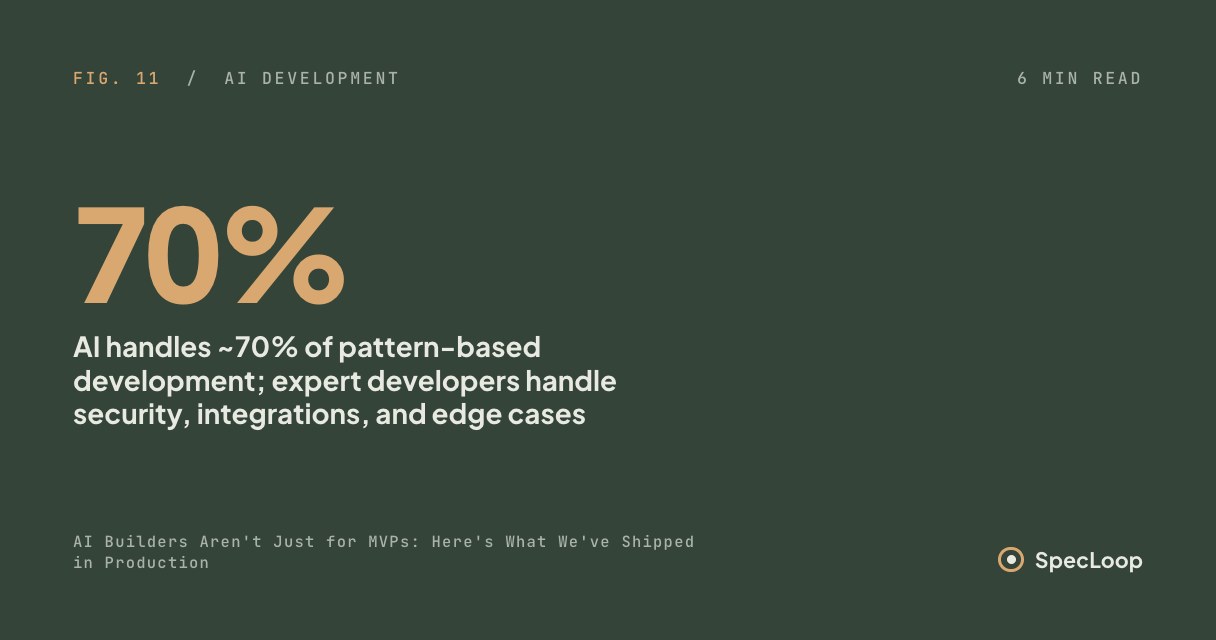
AI Builders Aren't Just for MVPs: Here's What We've Shipped in Production
Everyone says AI development platforms are 'great for prototypes but not real apps.' We've shipped enterprise-grade, multi-user production systems with them. Here's what's actually possible when experts operate these tools, and why the 'just for MVPs' narrative is wrong.
AI Development
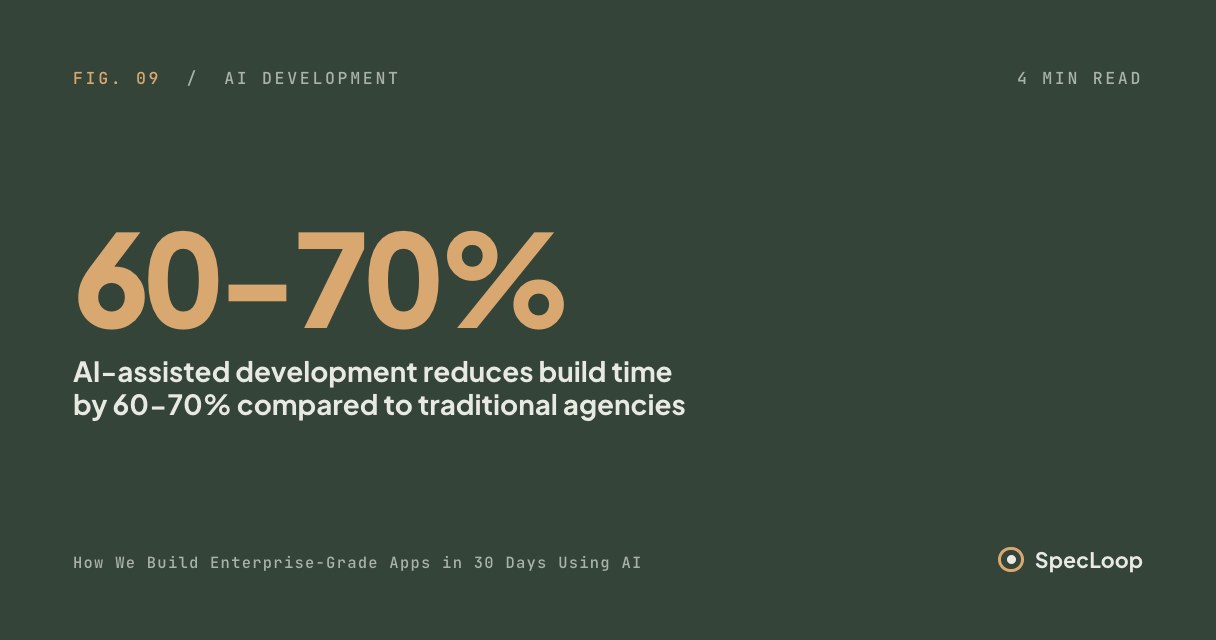
How We Build Enterprise-Grade Apps in 30 Days Using AI
A lot of people have been asking how we ship production-ready, full-stack business applications in 30 days at a flat rate. Here's exactly how our AI-powered development process works, and why it delivers enterprise-grade results faster than traditional agencies.
AI Development
Making Sense of OpenAI Models – The Complete Guide (May 30, 2025)
A plain-language breakdown of every OpenAI model family, reasoning, multimodal, and cost tiers, with guidance on which model to pick for chat, extraction, coding, and production workloads.
Next step
Want a spec for your build?
We write the full specification before any code is generated, then ship in 30–60 days at one flat rate. You own every line.