AI Development//6 min read/Jason Gordon
AI Builders Aren't Just for MVPs: Here's What We've Shipped in Production
Everyone says AI development platforms are 'great for prototypes but not real apps.' We've shipped enterprise-grade, multi-user production systems with them. Here's what's actually possible when experts operate these tools, and why the 'just for MVPs' narrative is wrong.
The "Just for MVPs" Myth
Go to any tech forum, any LinkedIn thread, any developer Slack channel, and you'll hear the same take: "AI builders like Bolt, Cursor, and v0 are great for prototypes and MVPs, but you'll need to rewrite everything when you want to go to production."
We hear this constantly. And it's wrong.
Not wrong in theory, wrong in practice. We've shipped dozens of production applications using AI-powered development platforms. Multi-user SaaS products. Partner portals with white-label domains. Financial management systems processing real transactions. CRMs managing real sales pipelines. These aren't demos. They're production systems used by real businesses every day.
Let's Be Clear
We're not saying AI tools can build anything without human expertise. We're saying AI tools, operated by experienced developers who understand architecture, security, and business logic, can deliver enterprise-grade results. The tool is the accelerator. The expertise is the engine.
What "Production" Actually Means
When we say production, we mean applications that meet these criteria:
- Multi-user authentication with email verification, session management, and role-based access control
- Row-Level Security (RLS) policies enforcing data isolation at the database level, not just frontend guards
- Server-side logic via edge functions handling webhooks, API integrations, and background processing
- Real-time features: live dashboards, notifications, collaborative editing
- Third-party integrations: Stripe payments, QuickBooks sync, Slack notifications, email delivery
- Error handling: error boundaries, retry logic, graceful degradation, monitoring
- Performance: code splitting, lazy loading, optimized database queries, CDN delivery
- SEO: server-rendered meta tags, structured data, sitemaps, crawler-friendly content
Every single one of these is achievable with AI-powered development platforms. We know, because we've done it.
What We've Actually Shipped
Here are real production systems we've built and deployed. Not prototypes. Not demos. Production.
1. Multi-Tenant Partner Portal
- White-label support with custom domain mapping per partner
- Role-based access: admin, partner, and client roles with different permissions
- Custom pricing calculator with partner-specific discount tiers
- Quote generation system with PDF export
- Branding customization per partner: logos, colors, domain
- Real-time dashboard with project status, revenue tracking, and activity logs
Architecture Note
The partner portal uses database-level RLS policies to ensure partners can only see their own data. This isn't a frontend filter, it's enforced at the PostgreSQL level. Even if someone bypasses the UI, the database won't return unauthorized data.
2. AI-Powered CRM System
- Lead management with pipeline visualization and drag-and-drop Kanban boards
- AI-powered lead scoring using conversation analysis
- Automated follow-up sequences triggered by pipeline stage changes
- Integration with email, calendar, and phone systems
- Custom reporting with exportable dashboards
- Activity logging for compliance and audit trails
3. Financial Management Platform
- QuickBooks Online integration via edge functions with OAuth token management
- AI invoice generation with line-item extraction from contracts
- Budget forecasting using historical data analysis
- Multi-currency support with real-time exchange rate updates
- Automated payment reminders and overdue notifications
- Role-based access: accountants see financials, managers see summaries, clients see invoices
4. Content & Marketing Platform
- ChatGPT and Claude integration for AI content generation
- SEO optimization with structured data, meta tags, and sitemap generation
- Blog publishing system with category management and search
- Newsletter system with subscriber management and email delivery
- Podcast hosting with audio player and episode management
- Website analysis tools: speed test, site grader, SEO audit
Why Most People Think AI Tools Can't Do This
The "just for MVPs" narrative comes from a real observation: most people who use AI development tools produce prototype-quality results. But the problem isn't the tool, it's the operator.
| Aspect | Inexperienced User | Expert Developer + AI |
|---|---|---|
| Database Design | Single flat table, no relations | Normalized schema with foreign keys, indexes, constraints |
| Authentication | Basic login, no session management | Multi-provider auth, MFA, session timeout, role-based access |
| Security | Frontend-only validation | RLS policies, server-side validation, input sanitization, CORS |
| Error Handling | Crashes silently | Error boundaries, toast notifications, retry logic, monitoring |
| API Integration | Hardcoded API keys in frontend | Server-side edge functions, secret management, webhook validation |
| Performance | Everything loads at once | Code splitting, lazy loading, optimized queries, CDN |
AI tools are force multipliers. Give them to someone who doesn't understand software architecture, and you get a pretty prototype that falls apart under real usage. Give them to a team that understands database design, security patterns, and production infrastructure, and you get enterprise-grade software in a fraction of the time.
The Expert Layer: What AI Can't Do (Yet)
We're not saying AI does everything. Here's where human expertise is still essential:
- Architecture decisions, Which tables need RLS? Where should business logic live, client, edge function, or database trigger?
- Security modeling: Who can access what? How do you prevent privilege escalation? Where are the attack surfaces?
- Integration design: How do you handle OAuth token refresh? What happens when a webhook fails? How do you retry gracefully?
- Data modeling: How do you handle multi-tenancy? What are the cascading delete rules? Where do you denormalize for performance?
- Edge case handling: What happens when a user has two roles? When a payment fails mid-transaction? When an API rate-limits you?
- Performance optimization: Which queries need indexes? Where are the N+1 problems? What should be cached?
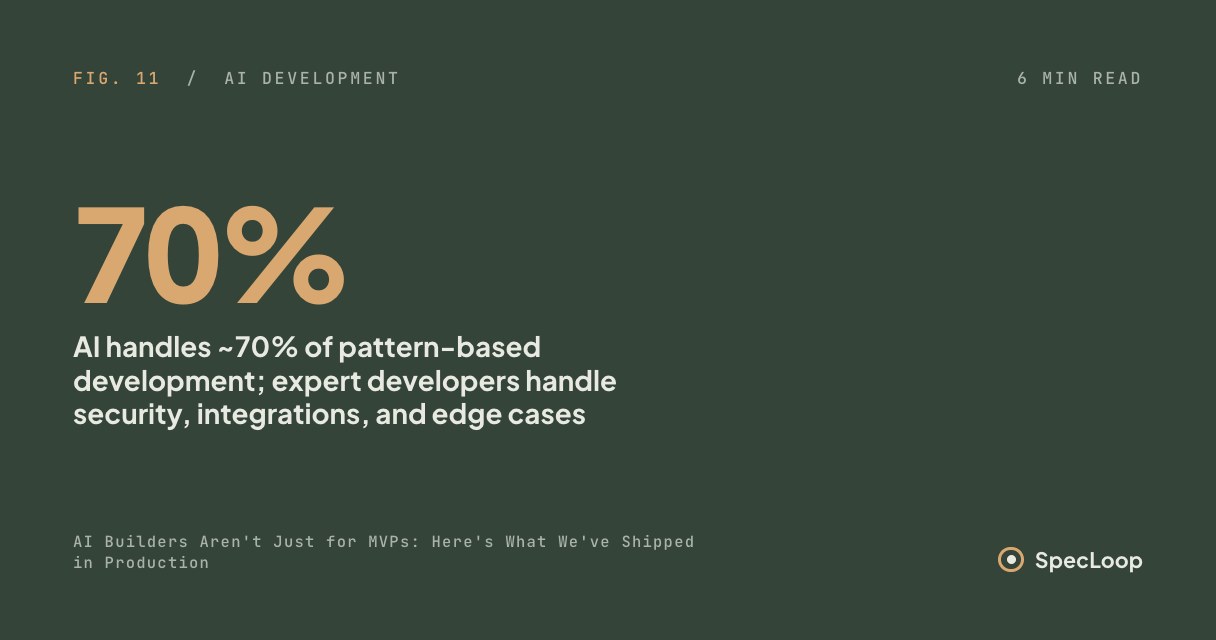
AI handles about 70% of the development work, the scaffolding, the UI components, the CRUD operations, the boilerplate. Our team handles the 30% that determines whether the app is production-ready or just a demo.
The Cost Comparison
This is where it gets really interesting. Because AI-powered development is faster, the economics change completely:
| Traditional Agency | SpecLoop (AI-Powered) | |
|---|---|---|
| Standard Business App | $50,000–$100,000 | $7,500 |
| Multi-User Team App | $80,000–$150,000 | $10,000 |
| SaaS Product | $150,000–$300,000 | From $15,000 |
| Timeline | 3–12 months | 30 days |
| Code Ownership | Often retained by agency | 100% yours |
| Billing Model | Hourly (scope creep risk) | Flat rate (fixed cost) |
These aren't discount apps. They're the same quality, often better, because AI-assisted code is more consistent and less prone to the bugs that come from developer fatigue on long projects.
When You Actually Need a Traditional Team
We're honest about this. There are cases where AI-powered development isn't the right fit:
- Heavily regulated industries requiring specific compliance frameworks (HIPAA, SOC 2 Type II, PCI DSS Level 1)
- Real-time systems with sub-millisecond latency requirements (trading platforms, gaming servers)
- Apps requiring native mobile with hardware access (Bluetooth, AR/VR, custom sensors)
- Legacy system migrations with millions of records and complex data transformation rules
For everything else, CRMs, financial tools, operations platforms, marketing systems, dashboards, portals, internal tools, AI-powered development delivers enterprise-grade results at a fraction of the cost and time.
The Bottom Line
AI development platforms aren't toys. They're not "just for prototypes." In the hands of experienced developers, they're the most efficient way to build production software that exists today.
The companies that figure this out first will build faster, spend less, and own their technology. The ones that don't will keep paying $100K+ for 6-month agency projects that deliver the same thing we ship in 30 days.
The gap isn't the tool. It's the expertise operating it. AI builders are exactly as powerful as the team using them.
Jason Gordon, CEO, SpecLoop
See What AI-Powered Development Can Build for You
Schedule a free consultation. We'll show you real production apps we've built, discuss your requirements, and give you a flat-rate quote.
Calculate Your ROI Schedule Discovery Call
Sources & References
- Supabase Row-Level Security - supabase.com/docs/guides/auth/row-level-security
- Deno Edge Functions - deno.com/deploy
- React 18 Documentation - react.dev
Get insights like this in your inbox
Join SpecLoop Insider for weekly deep-dives on custom software, AI, and operational efficiency. No fluff.
Subscribe
Frequently asked
Questions people ask about this
- Yes, when operated by engineers who enforce testing, RLS, and observability. We've shipped multi-tenant apps handling live customer data, payments, and role-based access on these platforms. The tool doesn't decide production-readiness, the operator does.
About the author
Jason Gordon
Founder, SpecLoop
Jason Gordon is the founder of SpecLoop, a spec-driven AI development studio that builds production-grade business applications from a complete specification, in weeks, at flat rate, with 100% code ownership. He also builds GeoTest, a free tool that scores how visible a site is to AI search engines. He writes about AI search, spec-driven development, and why most AI builds never reach production.
Keep reading
Related posts
AI Development
How We Build Enterprise-Grade Apps in 30 Days Using AI
A lot of people have been asking how we ship production-ready, full-stack business applications in 30 days at a flat rate. Here's exactly how our AI-powered development process works, and why it delivers enterprise-grade results faster than traditional agencies.
AI Development
The Claude Code Spec Workflow: Spec-Driven Development for AI Agents
Agentic coding tools like Claude Code get you to roughly 80% of a build and then stall. The missing ingredient is almost never model quality, it's specification. This is the practical spec-driven workflow we use to take AI agents from a fast prototype to a production-grade build.
AI Development
Making Sense of OpenAI Models – The Complete Guide (May 30, 2025)
A plain-language breakdown of every OpenAI model family, reasoning, multimodal, and cost tiers, with guidance on which model to pick for chat, extraction, coding, and production workloads.

AI Industry
Anthropic Just Raised $65 Billion. Here's Why It Matters.
On May 28, 2026, Anthropic closed a $65 billion Series H at a $965 billion post-money valuation, making the maker of Claude the most valuable AI startup on the planet and reshaping the competitive landscape for everyone building on top of frontier AI.
Next step
Want a spec for your build?
We write the full specification before any code is generated, then ship in 30–60 days at one flat rate. You own every line.