AI Development//3 min read/Jason Gordon
Making Sense of OpenAI Models – The Complete Guide (May 30, 2025)
A plain-language breakdown of every OpenAI model family, reasoning, multimodal, and cost tiers, with guidance on which model to pick for chat, extraction, coding, and production workloads.
🚀 Why Are There So Many OpenAI Models?
Think of OpenAI's model strategy like a toolbox rather than a single multi-tool.
Just as you wouldn't use a hammer for every home repair job, different AI tasks require specialized approaches.
OpenAI has evolved from its earlier approach (where GPT-3.5 and GPT-4 were expected to handle nearly everything) to a more nuanced ecosystem with:
🧠 Reasoning Specialists
(o-series) for complex problem-solving
💬 Chat Generalists
(GPT series) for versatile applications
⚡ Efficiency-Focused
For routine but high-volume tasks
🎨 Domain Experts
For images, speech, and specialized functions
📅 The OpenAI Model Timeline
2022-2023: Foundation Era
- GPT-3.5 Turbo (Nov 2022): The workhorse model that powered early ChatGPT
- GPT-4 (March 2023): Major leap in reasoning capabilities
- DALL·E 2 → DALL·E 3: Progressive image generation improvements
- Whisper (Sept 2022): Established speech recognition capabilities
2024: Diversification Phase
- GPT-4o (May 2024): Speed/performance optimizations
- o1 & o1-mini (July 2024): First dedicated reasoning models
- TTS-1 & TTS-1 HD (Aug 2024): Specialized text-to-speech
- text-embedding-3 (April 2024): Enhanced vector representations
2025: Specialization Era
- o3 & o3-mini (Jan 2025): Major reasoning advancement
- GPT-4.1 (March 2025): Latest flagship general model
- GPT-4.1 mini & nano (April 2025): Efficiency variants
- o4-mini (May 2025): Balanced reasoning performance
- GPT Image 1 (Feb 2025): State-of-the-art image generation
📊 Performance Deep Dive
| Model | Complex Math | Multi-step Planning | Compute Requirements |
|---|---|---|---|
| o3 | 92% accuracy | Excellent (10+ steps) | 100% (baseline) |
| o4-mini | 85% accuracy | Very Good (7-8 steps) | 60% |
| GPT-4.1 | 88% accuracy | Very Good (8-9 steps) | 95% |
💡 Real-world Impact
For financial modeling or complex scientific tasks, the difference between o3 and o3-mini might mean the difference between successfully analyzing a multi-variable problem and getting an incomplete solution.
🎯 Choosing the Right Model
Decision Tree Approach:
- 1: Complex reasoning or problem-solving?
→ Use o3 (premium) or o4-mini (balanced)
- 2: General content or conversation?
→ Use GPT-4.1 (quality) or GPT-4.1 mini (efficiency)
- 3: Media generation?
→ Use GPT Image 1 (premium) or DALL·E 3 (standard)
💼 Business Applications
Budget-Conscious
- Customer Support: GPT-4.1 nano
- Content Marketing: GPT-4o mini
- Data Analysis: o3-mini
Balanced Approach
- Customer Support: GPT-4o
- Content Marketing: GPT-4.1 mini
- Data Analysis: o4-mini
Performance-Focused
- Customer Support: GPT-4.1
- Content Marketing: GPT-4.1
- Data Analysis: o3
🚀 Strategic Approach
Many organizations adopt a tiered strategy, using performance-focused models for high-value, customer-facing content while deploying budget-conscious options for internal or draft work.
🔮 The Future Landscape
Based on current patterns, we anticipate these developments:
📈
GPT-4.2 (Expected Q3 2025)
- Enhanced contextual understanding and knowledge depth, 🧠
o5 (Expected Q4 2025)
Next major reasoning model with significant problem-solving improvements
🔗
Cross-modal Integration
Unification of text, image, audio, and potentially video capabilities
Why This Expertise Matters for Your Business
Understanding AI models isn't just academic, it's strategic. When we build your custom software, we select and combine the right AI capabilities for maximum impact and efficiency.
✓Right model for each specific task
✓Optimized cost and performance
✓Future-proof AI architecture
✓Strategic competitive advantage
Conclusion
OpenAI's model lineup has evolved from a few general-purpose tools to a sophisticated ecosystem of specialized capabilities. As of May 30, 2025, the key to success lies not in simply choosing the "best" model, but in strategically selecting and combining the right tools for each specific need.
By understanding the timeline, performance characteristics, and practical applications of each model, you can make informed decisions that balance capability, efficiency, and cost, ultimately delivering more effective AI solutions.
Update Schedule: This guide will be updated every three weeks to reflect new releases, performance improvements, and evolving best practices in the rapidly changing landscape of AI capabilities.
Next Update: June 20, 2025
Sources & references
Frequently asked
Questions people ask about this
- GPT-4o for balanced production workloads, o-series (o1, o3) for hard reasoning tasks, GPT-4o-mini for high-volume cheap classification, and specialized models (Whisper, DALL-E, TTS) for audio and image. Most apps mix models by task.
About the author
Jason Gordon
Founder, SpecLoop
Jason Gordon is the founder of SpecLoop, a spec-driven AI development studio that builds production-grade business applications from a complete specification, in weeks, at flat rate, with 100% code ownership. He also builds GeoTest, a free tool that scores how visible a site is to AI search engines. He writes about AI search, spec-driven development, and why most AI builds never reach production.
Keep reading
Related posts
AI Development
The Claude Code Spec Workflow: Spec-Driven Development for AI Agents
Agentic coding tools like Claude Code get you to roughly 80% of a build and then stall. The missing ingredient is almost never model quality, it's specification. This is the practical spec-driven workflow we use to take AI agents from a fast prototype to a production-grade build.
AI Development
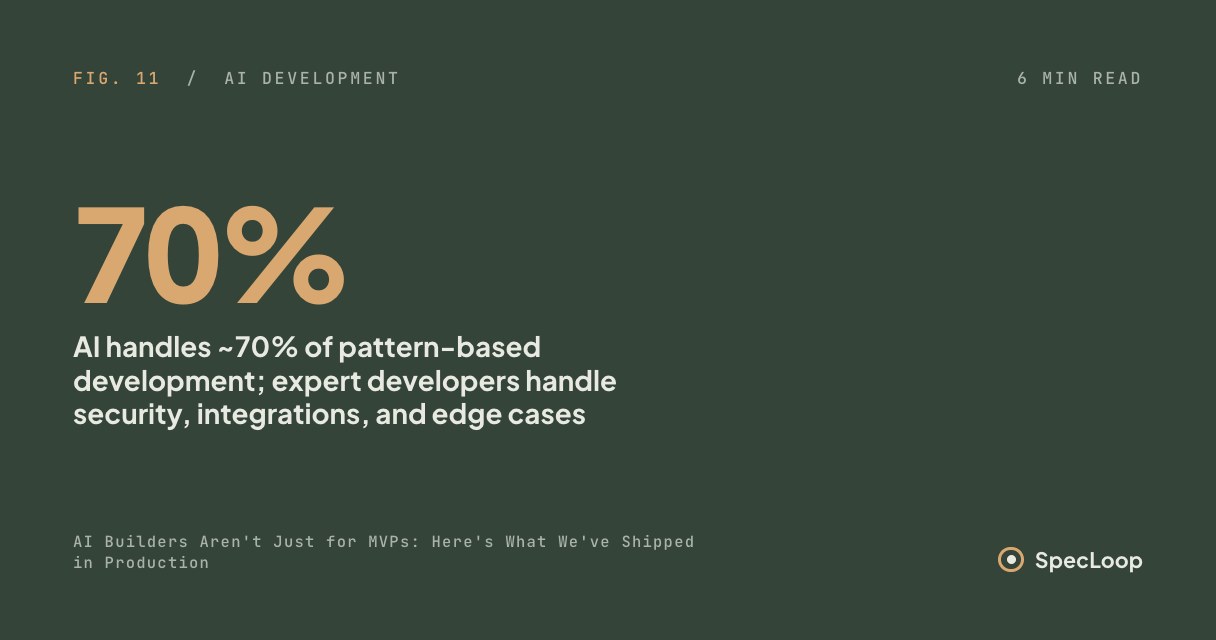
AI Builders Aren't Just for MVPs: Here's What We've Shipped in Production
Everyone says AI development platforms are 'great for prototypes but not real apps.' We've shipped enterprise-grade, multi-user production systems with them. Here's what's actually possible when experts operate these tools, and why the 'just for MVPs' narrative is wrong.
GEO & AI Search
How to Build a Site Fully Optimized for GEO in 2026
A lot of people have been asking how to build websites that AI search engines actually cite. This is the complete playbook, from architecture decisions to structured data to content strategy, for making your site a primary source in ChatGPT, Perplexity, Google AI Overviews, and every generative engine that matters.
AI Development
How We Build Enterprise-Grade Apps in 30 Days Using AI
A lot of people have been asking how we ship production-ready, full-stack business applications in 30 days at a flat rate. Here's exactly how our AI-powered development process works, and why it delivers enterprise-grade results faster than traditional agencies.
Next step
Want a spec for your build?
We write the full specification before any code is generated, then ship in 30–60 days at one flat rate. You own every line.