AI Industry//2 min read/Jason Gordon
Anthropic Just Raised $65 Billion. Here's Why It Matters.
On May 28, 2026, Anthropic closed a $65 billion Series H at a $965 billion post-money valuation, making the maker of Claude the most valuable AI startup on the planet and reshaping the competitive landscape for everyone building on top of frontier AI.
The numbers that don't look real
To grasp how fast this happened, look at the prior round. In February 2026, Anthropic raised $30 billion at a $380 billion valuation. Three months later, that figure has nearly tripled. The round was co-led by Altimeter Capital, Dragoneer, Greenoaks, and Sequoia Capital, with participation from Capital Group, Coatue, D1 Capital, and a previously committed $5 billion from Amazon.
The valuation isn't built on hype alone. Anthropic's annualized run-rate revenue crossed roughly $47 billion in May, up from about $10 billion at the end of 2025. A company growing revenue nearly fivefold in under six months, at that scale, is essentially without precedent.
It just passed OpenAI
For years, OpenAI was the default answer to "who's winning in AI." This round changes the headline. At $965 billion, Anthropic now sits above OpenAI's reported $852 billion valuation, making it, at least on paper, at least for now, the most valuable AI lab in the world. The two companies are trading the lead in public, and the gap is close enough that it could swing again. But the symbolism is hard to miss: the company once seen as the safety-focused challenger is now the front-runner.
| Lab | Valuation | Position |
|---|---|---|
| Anthropic | $965B | Most valuable AI lab (May 28, 2026) |
| OpenAI | $852B | Previous leader, still in close race |
| Anthropic (Feb 2026) | $380B | ~2.5x growth in three months |
Why the rest of us should care
It's tempting to file a number like $965 billion under "things happening to other people." It isn't. A raise of this size is a bet, by some of the most disciplined investors in the world, that AI demand is not a bubble about to pop but a market still early in its expansion. When frontier-model spending sets a new ceiling, it ripples outward: more capable models, faster release cycles, and lower costs for the businesses building on top of them.
The same week as the raise, Anthropic shipped Claude Opus 4.8 and teased a next-generation model. That cadence is the real story. The capital exists to fund compute, and the compute exists to fund better tools, the kind that let small teams build software that used to require an army of engineers.
What this means for builders
Frontier capability is compounding faster than most product roadmaps assume. Teams that design their stack to swap in better models quarterly, not yearly, will compound that advantage.
What's next
This is widely expected to be Anthropic's last private raise before an IPO, with an October 2026 window now in view. If it lands near this valuation, it would be one of the biggest tech IPOs ever, and a milestone moment for AI moving from "promising" to permanent infrastructure.
For anyone building in or around this space, the message is simple: the foundation everyone is building on just got a lot more capital, a lot more capable, and a lot harder to ignore.
Get insights like this in your inbox
Join SpecLoop Insider for weekly deep-dives on custom software, AI, and operational efficiency. No fluff.
Subscribe
Sources & references
Frequently asked
Questions people ask about this
- Frontier model training now costs billions per generation, and the compute reservation for the next generation of Claude requires funding years ahead. The $65B round secures multi-year GPU capacity and lets Anthropic keep pace with OpenAI and Google.
About the author
Jason Gordon
Founder, SpecLoop
Jason Gordon is the founder of SpecLoop, a spec-driven AI development studio that builds production-grade business applications from a complete specification, in weeks, at flat rate, with 100% code ownership. He also builds GeoTest, a free tool that scores how visible a site is to AI search engines. He writes about AI search, spec-driven development, and why most AI builds never reach production.
Keep reading
Related posts
Strategy
The Agentic Coding Shift: Why Mid-Market Teams Are Building Custom Again
Agentic AI just collapsed the cost and timeline of custom software. The old "buy SaaS, don't build" rule was a response to economics that no longer exist. Here's why mid-market teams are quietly going back to custom, and what to build first.
GEO & AI Search
Google Just Killed the Search Box: What I/O 2026 Means for Every Business With a Website
Five days ago at Google I/O 2026, Google announced the biggest change to Search in 25 years, the search bar is being replaced by AI agents. If your website was built to rank on a results page that no longer exists, you have a problem. Here's what changed, why it matters, and what to do this quarter.
AI Development
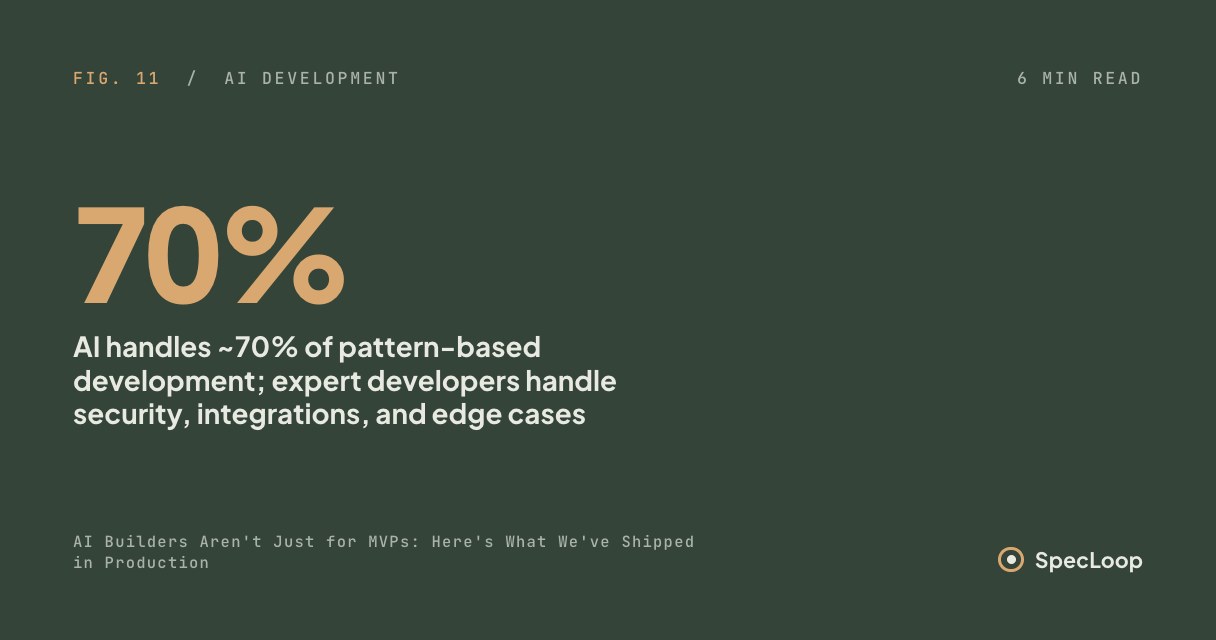
AI Builders Aren't Just for MVPs: Here's What We've Shipped in Production
Everyone says AI development platforms are 'great for prototypes but not real apps.' We've shipped enterprise-grade, multi-user production systems with them. Here's what's actually possible when experts operate these tools, and why the 'just for MVPs' narrative is wrong.
How-To
Trailing Slashes: The URL Decision Nobody Makes
/pricing and /pricing/ are two different URLs to your server, to Google and to your analytics. Most sites never pick one. Here is why it costs you, which form to choose, how we set it on Vercel and in custom code, and a curl loop that audits any site in ten minutes.
Next step
Want a spec for your build?
We write the full specification before any code is generated, then ship in 30–60 days at one flat rate. You own every line.