AI Development//5 min read/Jason Gordon
How We Build Enterprise-Grade Apps in 30 Days Using AI
A lot of people have been asking how we ship production-ready, full-stack business applications in 30 days at a flat rate. Here's exactly how our AI-powered development process works, and why it delivers enterprise-grade results faster than traditional agencies.
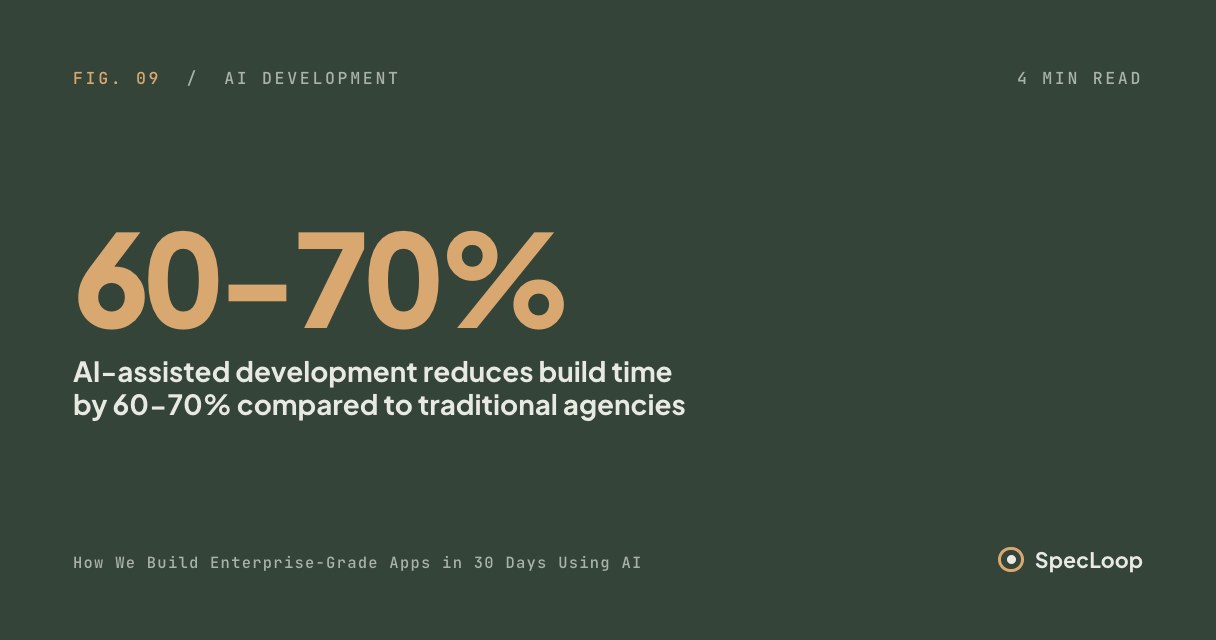
The Problem With Traditional App Development
Most businesses that come to us have the same story: they went to an agency, got quoted $50,000–$150,000, waited 6–12 months, and ended up with something that barely works. Or they tried building it themselves with no-code tools and hit a wall when they needed real integrations, multi-user auth, or anything beyond a basic CRUD app.
The traditional model is broken. Hourly billing incentivizes agencies to take longer. Waterfall planning means you don't see working software until months in. And the final product is usually a bloated codebase that costs a fortune to maintain.
The SpecLoop Difference
We build custom, enterprise-grade applications at flat rates ($7,500–$15,000) and deliver in 30 days. No hourly billing. No scope creep. No surprises. You own 100% of the code.
Our AI-Powered Development Stack
We don't just use AI as a gimmick, it's the core of our development workflow. AI handles the repetitive scaffolding, boilerplate, and pattern implementation, while our team focuses on architecture decisions, security, integration logic, and the complex business rules that AI can't figure out on its own.
| Faster than traditional development | 60–70% |
| Concept to production | 30 days |
| Flat-rate pricing | $7.5K–$15K |
| Code ownership | 100% |
The Tech Stack
Every application we build runs on production-grade infrastructure. This isn't a prototype stack, it's the same technology powering apps with thousands of users:
- React 18 + TypeScript: Type-safe, component-based UI that scales from MVP to enterprise
- Supabase: PostgreSQL database, authentication, real-time subscriptions, storage, and edge functions
- Edge Functions (Deno): Server-side logic for API integrations, webhooks, and background jobs
- Row-Level Security (RLS): Database-level access control, not just frontend auth checks
- Tailwind CSS + shadcn/ui: Consistent, responsive design system without CSS bloat
- Vite: Sub-second hot module replacement during development, optimized production builds
Not a Prototype Stack
This is the same stack used by Y Combinator startups, enterprise SaaS products, and companies processing millions in transactions. It scales vertically and horizontally.
The 30-Day Process: Week by Week
Week 1: Discovery & Architecture
- Day 1–2: Discovery call, requirements gathering, user story mapping
- Day 3–4: Database schema design, API contract definition, integration planning
- Day 5: Architecture review, security model design, deployment strategy
This isn't a "tell us your idea and we'll figure it out" phase. We come out of Week 1 with a complete technical blueprint: database schema, API contracts, auth flow, and integration specs. You approve it before we write a single line of code.
Week 2: Core Build
- Database tables, RLS policies, and auth system deployed
- Core UI components built with real data, no mock screens
- Primary business logic implemented and tested
- API integrations connected (Stripe, QuickBooks, Slack, etc.)
- First demo with live data, you can click through a working app
Real Data, Not Mockups
By the end of Week 2, you're interacting with a working application connected to a real database. Not Figma. Not a clickable prototype. A working app.
Week 3: Feature Completion & Integration
- All secondary features built and connected
- Edge functions deployed for server-side logic
- Email notifications, webhooks, and background jobs configured
- Role-based access control tested across all user types
- Performance optimization and responsive design verified
Week 4: Polish, Test & Launch
- End-to-end testing across all user flows
- Security audit: RLS policies, input validation, auth edge cases
- SEO optimization: meta tags, structured data, sitemap
- Documentation: user guide, API reference, admin manual
- Training session with your team
- Production deployment and DNS configuration
- Post-launch monitoring for 48 hours
What "Enterprise-Grade" Actually Means
When we say enterprise-grade, we mean specific things, not marketing fluff:
| Feature | Prototype/MVP | SpecLoop Enterprise-Grade |
|---|---|---|
| Authentication | Basic email/password | Email, OAuth, MFA, session management, role-based access |
| Authorization | Frontend route guards only | Database-level RLS policies + server-side validation |
| API Security | No validation | Zod schema validation, rate limiting, CORS, JWT verification |
| Data Model | Single-user, flat tables | Multi-tenant, relational, with cascading deletes and constraints |
| Error Handling | Console.log | Error boundaries, toast notifications, retry logic, Sentry integration |
| Deployment | npm run build → upload | CI/CD pipeline, preview environments, automated deploys |
Why Flat-Rate Pricing Changes Everything
Hourly billing is a perverse incentive. The longer a project takes, the more the agency makes. That's why traditional projects balloon from $50K to $150K and from 3 months to 12 months.
Our flat-rate model flips this. We're incentivized to build efficiently because our profit margin depends on it. AI-powered development makes this possible, we can deliver in 30 days what would take a traditional team 3–6 months.
- $7,500: Standard Business App
- $10,000: Internal Team App
- $15,000+: SaaS Product
$0/mo
No Ongoing Fees
Every tier includes: full source code ownership, deployment, documentation, training session, and 30 days of post-launch support. No hidden fees. No "Phase 2" upsells.
Real Examples: What We've Shipped
These aren't hypothetical, these are production apps we've delivered to real businesses:
- Multi-tenant CRM with AI-powered lead scoring, pipeline management, and automated follow-up sequences
- Financial management platform with QuickBooks integration, invoice generation, and budget forecasting
- Partner portal with white-label support, custom domain mapping, role-based access, and real-time dashboards
- AI-powered content platform with ChatGPT integration, SEO optimization, and automated publishing workflows
- Operations management system with resource allocation, project tracking, and team workload balancing
Every App Ships With
Authentication, database, API integrations, responsive design, SEO, documentation, and deployment. These aren't add-ons, they're standard.
Who This Is For
- Businesses paying $500+/month for SaaS tools they've outgrown
- Companies that got burned by a $100K agency project that didn't deliver
- Founders who need a production app, not another prototype
- Teams that want to own their software instead of renting it
- Operations leaders who need custom workflows, not generic software
The Bottom Line
AI-powered development isn't about replacing developers, it's about amplifying what a skilled team can deliver. We use AI to handle the 70% of development that's pattern-based, and our team handles the 30% that requires architecture, security, and business logic expertise.
The result: enterprise-grade applications in 30 days, at flat rates that are 80% less than what traditional agencies charge. And you own every line of code.
Sources & references
Frequently asked
Questions people ask about this
- The bottleneck used to be code generation. Agentic tools removed it. What remains, specification, architecture review, testing, deployment, is what our 30-day process focuses on. The AI writes; humans direct, review, and harden.
About the author
Jason Gordon
Founder, SpecLoop
Jason Gordon is the founder of SpecLoop, a spec-driven AI development studio that builds production-grade business applications from a complete specification, in weeks, at flat rate, with 100% code ownership. He also builds GeoTest, a free tool that scores how visible a site is to AI search engines. He writes about AI search, spec-driven development, and why most AI builds never reach production.
Keep reading
Related posts
Engineering
The Hidden Cost of Technical Debt: When to Rebuild vs. Patch
A lot of people have been asking us how to know when their aging software is costing more to maintain than it would to replace. Here's the framework we use with our clients.
AI Development
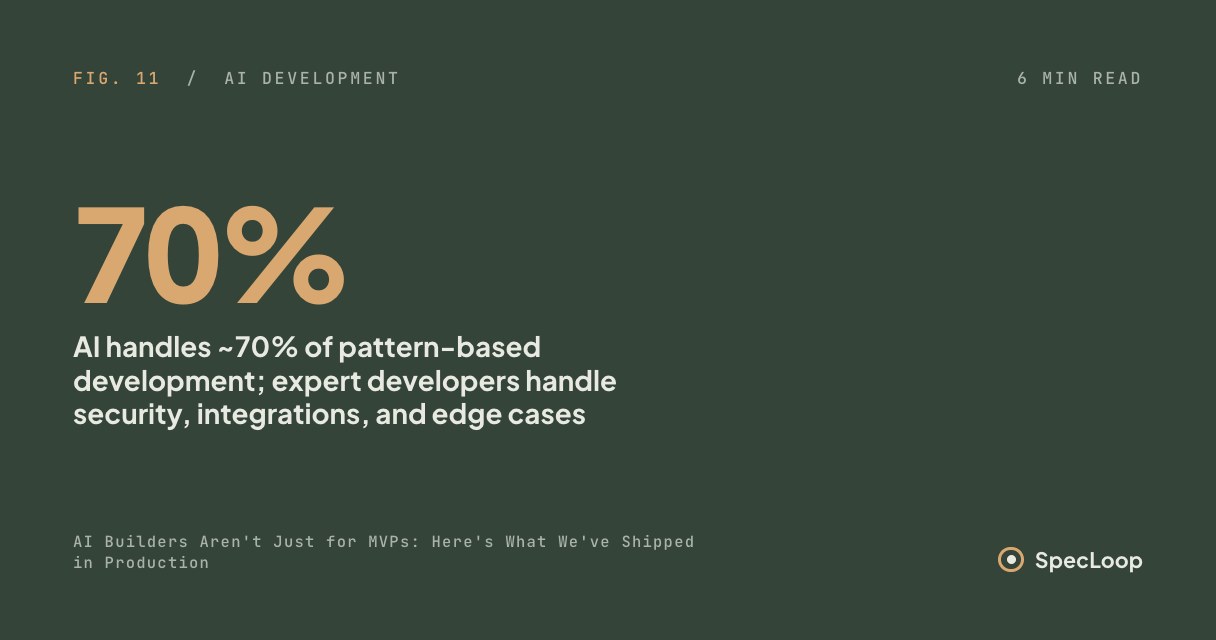
AI Builders Aren't Just for MVPs: Here's What We've Shipped in Production
Everyone says AI development platforms are 'great for prototypes but not real apps.' We've shipped enterprise-grade, multi-user production systems with them. Here's what's actually possible when experts operate these tools, and why the 'just for MVPs' narrative is wrong.
GEO & AI Search
Why Blog Posts Should Be 2,500+ Words If You Want AI to Cite You
A lot of people have been asking us why we recommend long-form content for every client's blog strategy. The short answer: AI search engines don't cite thin content. Here's the full breakdown, the data, the mechanics, and the framework for getting your content quoted by ChatGPT, Perplexity, and Google AI Overviews.
GEO & AI Search
How to Build a Site Fully Optimized for GEO in 2026
A lot of people have been asking how to build websites that AI search engines actually cite. This is the complete playbook, from architecture decisions to structured data to content strategy, for making your site a primary source in ChatGPT, Perplexity, Google AI Overviews, and every generative engine that matters.
Next step
Want a spec for your build?
We write the full specification before any code is generated, then ship in 30–60 days at one flat rate. You own every line.