1. Executive Summary
A silent performance crisis is currently undermining digital advertising budgets across every sector. Organizations investing aggressively in platforms like Google Ads, Meta, and LinkedIn are frequently operating on degraded, incomplete conversion data. This is not a creative or budgetary failure. It is an infrastructure failure, and it is addressable.
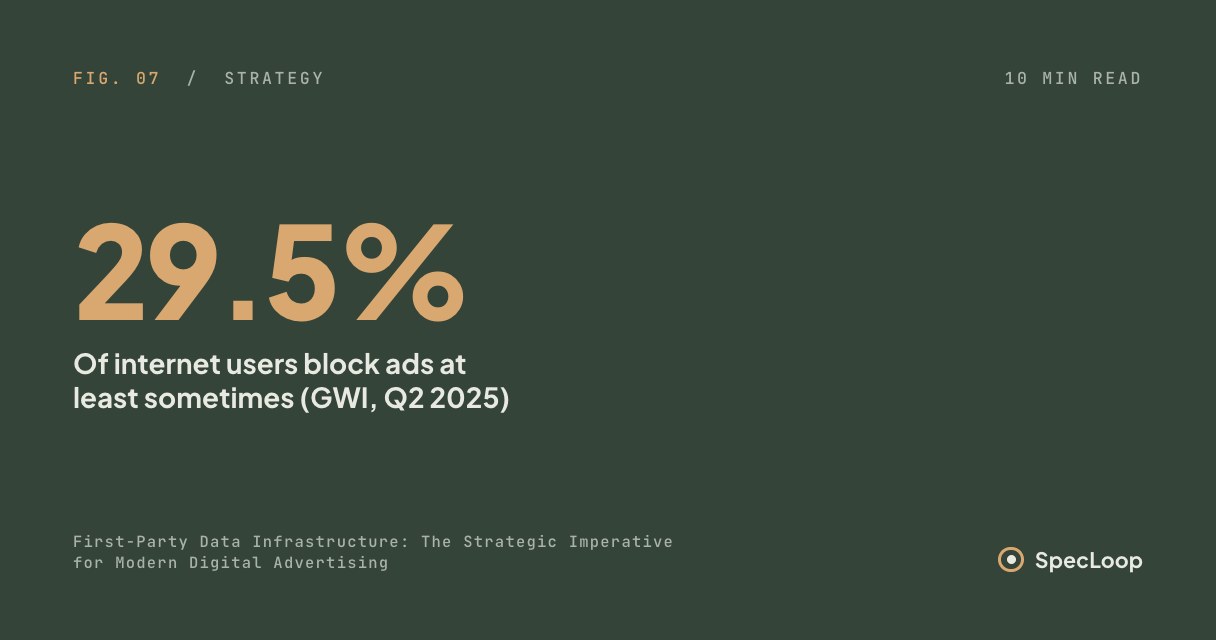
Current data indicates that 29.5% of internet users block ads at least sometimes (GWI via Backlinko, Q2 2025), while browser-level privacy restrictions have reduced Safari third-party cookie lifespans to a mere 7 days. Enterprise firewalls block Google's tag delivery domains by default, rendering significant conversion volume invisible to advertising platforms.
The result: machine learning models optimizing against a distorted reality, bid strategies starved of signal, and attribution gaps that widen with every passing quarter.
Organizations that transition to resilient, first-party data pipelines recover an average of 8–15% of previously unmeasured conversions (Brainlabs, 2024), directly improving algorithmic bid performance, attribution accuracy, and return on ad spend. Google's own research confirms that advertisers using enhanced first-party signal pipelines see 5% more conversions at equivalent cost.
The organizations building reliable first-party data pipelines today are compounding a performance advantage that budget increases alone cannot replicate.
2. The Erosion of Third-Party Data Infrastructure
2.1 The Cookie Deprecation Timeline
The structural compromise of the third-party cookie has accelerated through a decade of privacy-centric milestones:
- 2017: Apple introduces Intelligent Tracking Prevention (ITP) in Safari
- 2019: Firefox enables Enhanced Tracking Protection (ETP) by default
- 2021: Apple's App Tracking Transparency (ATT) decimates mobile signal quality
- 2022: ITP reduces third-party cookie persistence to 7 days
- 2024: Google begins phased third-party cookie deprecation in Chrome
- 2026: Privacy Sandbox APIs become the default in Chrome
2.2 The Ad-Blocking Reality
Ad-blocking and script-blocking are no longer niche behaviors. They are mainstream consumer practices with material business consequences.
| Data Point | Metric | Source |
|---|---|---|
| Global Ad-Block Usage | 29.5% of internet users | GWI via Backlinko, Q2 2025 |
| Enterprise Firewall Blocking | 42% block googletagmanager.com | Forrester, Q3 2024 |
| Mobile Ad-Blocking Growth | 23% year-over-year | PageFair, 2024 |
2.3 The Signal Loss Cascade
Signal loss operates as a compounding cascade that most organizations misdiagnose, attributing the symptoms to creative fatigue or audience saturation when the root cause is infrastructure failure.
- Conversions go untracked
- Algorithmic bid strategies receive fewer signals
- Smart Bidding underperforms: CPAs rise, ROAS falls
- Budget reallocated away from high-performing channels
- Strategic decisions made on structurally flawed data
- Competitive gap widens as peers compound their advantage
3. The First-Party Data Maturity Model
Organizations do not implement first-party data infrastructure in a single initiative. They progress through a structured maturity curve.
1. Basic GTM Installation
Data Quality: Poor
GTM container is present but unmanaged. Legacy tags firing unnecessarily. No clear ownership.
Business Impact: Advertising platforms receiving the least accurate signal possible. Smart Bidding is effectively flying blind.
2. Validated Tag Configuration
Data Quality: Baseline
All active tags are intentional, correctly configured, and validated. Clear governance with defined owners and documented approval process.
Business Impact: Reliable foundation, minimum viable state for trustworthy advertising data.
3. Enhanced Conversions Active
Data Quality: Good
Hashed first-party customer data transmitted alongside conversion events. CRM integration firing server-to-server signals.
Business Impact: Attribution gaps from Safari and Firefox users close substantially.
4. Tag Gateway Implemented
Data Quality: Very Good
GTM container delivered from your own domain via CNAME. Ad-blocker bypass active. Cookie persistence extended to 400 days.
Business Impact: The roughly 30% of users previously blocking your tags now contribute to your conversion signal.
5. Server-Side GTM + CRM Integration
Data Quality: Excellent
Tag execution on a cloud server you control. Full data governance, PII filtering, and multi-vendor event routing.
Business Impact: Maximum algorithmic performance. Complete data governance. Future-proof.
Where does your organization sit? Most businesses beginning this journey in 2026 are at Level 1 or Level 2. Each level represents a compounding improvement. The strategic imperative is to move deliberately and sequentially, each level depends on the integrity of the one beneath it.
4. Google Tag Manager: The Governance Foundation
4.1 The Governance Imperative
Google Tag Manager is deceptively simple to start and deceptively complex to maintain well. Enterprise GTM containers accumulate technical debt rapidly, orphaned tags, broken triggers, conflicting GA4 configurations, and security vulnerabilities from outdated tag templates.
Tag Gateway is a delivery optimization. It does not fix a broken container. A misconfigured GTM container delivered via first-party domain is still a misconfigured GTM container.
4.2 The Non-Negotiable Implementation Sequence
- Audit: Identify and remove orphaned or conflicting tags
- Validate: Use GTM Preview Mode and GA4 DebugView to confirm correct firing logic
- Govern: Define ownership, publish approval process, and version documentation
- Implement Tag Gateway: Optimize delivery only after the foundation is clean
4.3 Container Audit Checklist
✓Document purpose and owner of every active tag
✓Confirm all tags fire correctly in Preview Mode
✓Remove or archive orphaned tags
✓Revoke access for former agencies and vendors
✓Document version history for rollback capability
✓Confirm correct GA4 Measurement ID
✓Validate matching platform-side conversion actions
✓Confirm triggers match actual user behavior
✓Ensure all data layer variables populate correctly
✓Create clean baseline record for future governance
5. Google Tag Gateway: Technical Architecture
5.1 The Reverse Proxy Mechanism
Google Tag Gateway operates as a reverse proxy. Standard GTM deployment loads from googletagmanager.com, a domain on every major ad-blocker list. Tag Gateway routes the same request through your own subdomain (e.g., gtm.yourdomain.com), making it indistinguishable from first-party content.
❌ Standard (Blocked)
Host: googletagmanager.com
Intercepted by ad-blockers. No tags fire. No conversions recorded.
✅ Tag Gateway (First-Party)
Host: gtm.yourdomain.com
Treated as first-party. Block list rules don't apply. Tags fire normally.
5.2 Implementation Pathways
Path A: Cloudflare One-Click
Timeline: 1–4 hours
DNS managed directly on your Cloudflare account with full admin access.
⚠️ Unavailable for managed hosting (Kinsta, WP Engine, Pantheon).
Path B: Manual DNS/CNAME Configuration
Timeline: 1–3 weeks
Create CNAME record (e.g., gtm.yourdomain.com → Google's endpoint). Most common enterprise path.
Path C: Server-Side GTM
Timeline: 4–8 weeks
Tag execution moves to your cloud server (GCP, AWS, Azure). Highest long-term value and full data control.
5.3 The Business Case: Quantified
| Metric | Impact | Source |
|---|---|---|
| Conversion Recovery | 8–15% uplift | Brainlabs, 2024 |
| Smart Bidding Performance | 5% more conversions | Google Internal, 2024 |
| Safari Cookie Persistence | 7 days → 400 days | WebKit ITP Docs |
| Ad-Blocker Bypass | up to ~30% of users recovered | GWI via Backlinko, Q2 2025 |
| ROAS Improvement | 12–18% average | Google Ads Help, 2025 |
6. Enhanced Conversions: The Identity Layer
GTG vs. Enhanced Conversions: Complementary, Not Interchangeable
| Mechanism | Problem Solved | Method |
|---|---|---|
| Tag Gateway | Ad-blocker blocking, cookie restrictions | First-party domain delivery |
| Enhanced Conversions | Cookieless attribution (ITP, no cookie) | Hashed identity matching via Google account |
Together, they cover the full spectrum of signal loss. GTG ensures the tag fires and the cookie persists. Enhanced Conversions ensures attribution succeeds even when no cookie exists at all.
CRM Integration: The Highest-Leverage Implementation
The most powerful implementation is a server-to-server integration between your CRM and Google's Conversion API, bypassing the browser entirely. When a lead converts in HubSpot, a conversion signal fires directly to Google Ads with:
→Zero ad-blocker exposure, server-to-server, never touches the browser
→Zero cookie dependency, matching via hashed identity
→True business outcomes, signals based on CRM deal stages
→Offline conversion support, accounts for off-site sales cycles
7. Operational Execution and AI Integration
7.1 Infrastructure Dependency Checklist
Confirm every item below before any implementation work begins:
- DNS Provider identified
- DNS Admin Access confirmed
- Hosting Provider identified
- Cloudflare status determined (Personal / Managed)
- GTM Container Access level confirmed
- GTM Container Owner identified
- Legacy Tag Audit completed
- IT/DevOps Contact assigned
- DNS Change Approval Process documented
- Implementation Timeline stakeholder-approved
7.2 AI-Assisted Implementation Framework
- Human: Define requirements + inject full infrastructure context
- AI: Generate tag configurations, triggers, and variables
- Human: Review AI output for architectural accuracy
- GTM Preview Mode: Test all tags in isolated environment
- Human: Validate data in GA4 DebugView and Ads Diagnostics
- Stakeholder: Approve before publish
- Publish: New container version goes live
- Monitor: Confirm data flowing 24–48 hours post-publish
AI accelerates the generation phase. It does not replace the validation phase. This distinction is critical and non-negotiable.
8. Strategic Recommendations
For CMOs and Marketing Leadership
1. Quantify your signal loss before building the business case.
Use GA4 data quality indicators and browser-segmented conversion rate analysis. A significant gap between Chrome and Safari rates is direct evidence of ITP-driven signal loss.
2. Reframe infrastructure investment as advertising investment.
A 10% improvement in signal quality translates directly to lower CPAs and higher returns on existing spend.
3. Use the Maturity Model as your 12-month strategic roadmap.
Identify your current level, define your target, and build a sequenced plan. Do not attempt to jump from Level 1 to Level 4 in a single initiative.
For IT and DevOps Leadership
1. Conduct infrastructure discovery before any project commitment.
Confirm DNS provider, Cloudflare status, and the DNS change approval process. This discovery determines project success.
2. If hosted on Kinsta/WP Engine/Pantheon, assume Path A is unavailable.
Budget for manual GTM configuration. Engage your DNS team proactively at project initiation.
3. Establish GTM governance as a standing operational practice.
Define container ownership, require documented justification for new tags, and schedule quarterly audits.
9. Comprehensive FAQ
Q1: Do we still need to set up tags in GTM even if we implement Tag Gateway?
Yes, absolutely. GTG only changes how your GTM container is delivered. It has zero effect on what tags are inside that container. Tag configuration is a completely separate workstream that must be completed correctly before Tag Gateway provides any value. Think of GTG as upgrading the delivery truck, you still need to pack the boxes.
Q2: We're hosted on Kinsta. Can we use the Cloudflare one-click GTG setup?
Almost certainly not. Kinsta operates a managed enterprise Cloudflare account on behalf of its customers. Your path is Manual GTM Configuration (Path B), which requires CNAME access through your primary DNS provider. Confirm DNS administrative access with your IT team before committing to any timeline.
Q3: What's the difference between Tag Gateway and Enhanced Conversions? Do we need both?
They solve fundamentally different problems. Tag Gateway ensures your GTM container loads and cookies persist as first-party. Enhanced Conversions uses hashed identity data for attribution when no cookie exists at all. You ideally want both. If choosing one first, prioritize Enhanced Conversions.
Q4: Will Tag Gateway immediately improve our Google Ads results?
Not immediately, but progressively. Smart Bidding requires a 2–4 week learning period. Expect gradual CPA and ROAS improvement over 4–8 weeks. Do not evaluate during the learning period.
Q5: What happens if GTG is implemented incorrectly?
Incorrect GTG configuration is unlikely to break your site. The most likely outcome is the connection simply doesn't establish and your GTM container falls back to loading from Google's standard domain. However, incorrect tag configurations can break tracking independently of GTG.
Q6: Can AI tools set up GTM tags and GTG for us?
AI can meaningfully accelerate the process, but cannot discover infrastructure constraints, test tags in Preview Mode, or validate data flow. The right framework is: AI generates → human reviews → Preview Mode tests → stakeholder approves → publish → monitor.
Q7: How long does a full GTG implementation take?
Cloudflare one-click: 1–4 hours. Manual DNS with IT engaged at kickoff: 3–5 business days. Manual DNS with Azure coordination: 1–3 weeks. Server-Side GTM: 4–8 weeks. The practical lesson: engage IT/DNS teams at project initiation.
Q8: Is Tag Gateway worth it if our ad-blocking rate appears low?
Yes. Your measured ad-blocking rate is likely understated, users blocking scripts also block the analytics that would record them. Additionally, GTG delivers value through cookie persistence improvement for Safari/Firefox users under ITP.
10. Conclusion
In the modern digital advertising landscape, infrastructure is a compounding competitive advantage. Organizations that build resilient, first-party data pipelines today enable their machine learning algorithms to learn faster, optimize more effectively, and outperform competitors still relying on degraded, third-party signal infrastructure.
The implementation path is clear. The business case is quantified. The infrastructure dependencies are mappable and manageable. The Maturity Model provides a sequenced roadmap from wherever your organization currently sits to wherever it needs to go.
The question is not whether to invest in first-party data infrastructure. The question is how many quarters you can afford to wait before the performance gap becomes insurmountable.
Sources & References
1. PageFair Global Ad Block Report, 2024
pagefair.com
2. Forrester: State of Enterprise Network Security, Q3 2024
forrester.com
3. Brainlabs: First-Party Data Conversion Recovery Study, 2024
brainlabs.com
4. Google Internal Research: Enhanced Signal Pipeline Performance, 2024
ads.google.com
5. WebKit ITP Documentation: Cookie Persistence Specifications
webkit.org
6. Google Ads Help Center: ROAS Improvement Benchmarks, 2025
support.google.com/google-ads
7. Google Tag Manager: Tag Gateway Technical Documentation
developers.google.com/tag-platform
Additional sources: Industry analysis from Tealium, Segment, and enterprise GTM deployment case studies.
Sources & references
- Backlinko: Ad blocker usage statistics (GWI, Q2 2025: 29.5% of internet users block ads at least sometimes)
- WebKit: Intelligent Tracking Prevention 2.1 (7-day cap on script-written cookies)
- WebKit: Full third-party cookie blocking and more
- Google: Tag Gateway for advertisers
- Google Ads Help: About enhanced conversions
Frequently asked
Questions people ask about this
- The pipeline that collects, stores, and activates data your business owns directly, from your site, app, and CRM, without depending on third-party cookies or ad-platform pixels that browsers and regulators are systematically blocking.
About the author
Jason Gordon
Founder, SpecLoop
Jason Gordon is the founder of SpecLoop, a spec-driven AI development studio that builds production-grade business applications from a complete specification, in weeks, at flat rate, with 100% code ownership. He also builds GeoTest, a free tool that scores how visible a site is to AI search engines. He writes about AI search, spec-driven development, and why most AI builds never reach production.
Keep reading
Related posts
Strategy
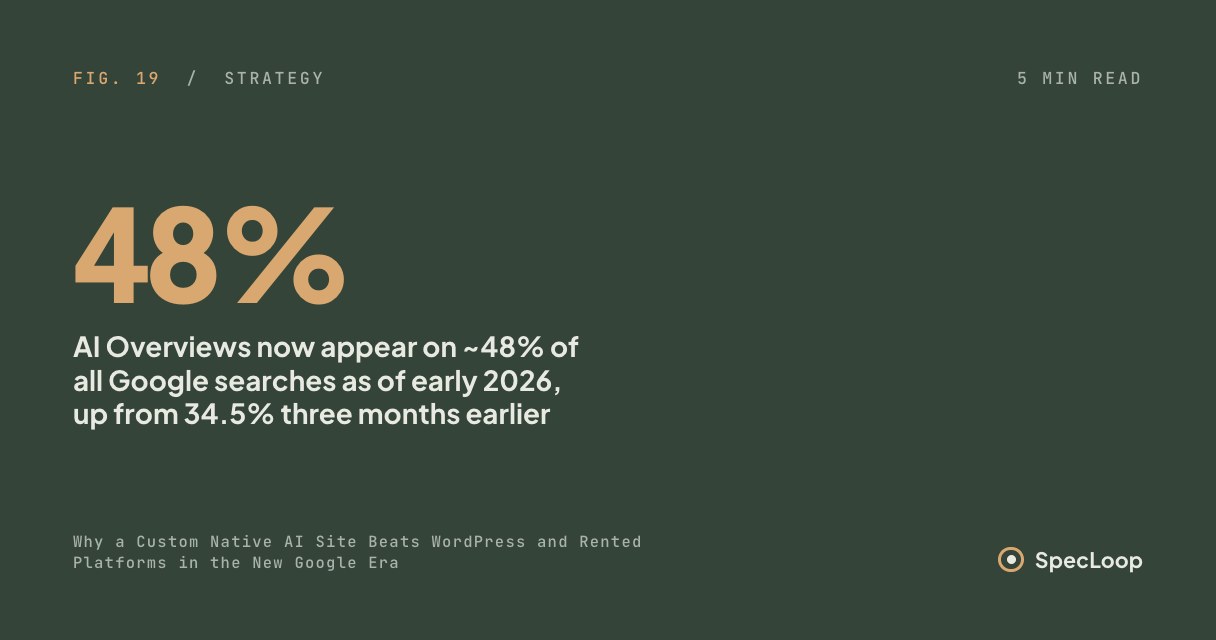
Why a Custom Native AI Site Beats WordPress and Rented Platforms in the New Google Era
Google's AI Overviews now appear on nearly half of all searches and are cutting organic traffic 20–40%. Here's why rebuilding on a custom native site is the only durable answer for security, speed, and AI visibility.
Strategy
Generative Engine Optimization (GEO): The Complete Guide to AI Search Visibility in 2025
A Strategic White Paper for Business Leaders - Master the transformation from traditional SEO to AI-powered search optimization
Strategy
Why We're Moving Our Clients Off WordPress
We still maintain dozens of WordPress sites. Here's the honest operator view from inside the stack, what changed, why we're migrating our own book of business to custom native sites, and how we do it without breaking anything.
Strategy
The Agentic Coding Shift: Why Mid-Market Teams Are Building Custom Again
Agentic AI just collapsed the cost and timeline of custom software. The old "buy SaaS, don't build" rule was a response to economics that no longer exist. Here's why mid-market teams are quietly going back to custom, and what to build first.
Next step
Want a spec for your build?
We write the full specification before any code is generated, then ship in 30–60 days at one flat rate. You own every line.